
Does having a valid Work Permit guarantee compliance for foreign employees in Vietnam? Không nhất thiết.
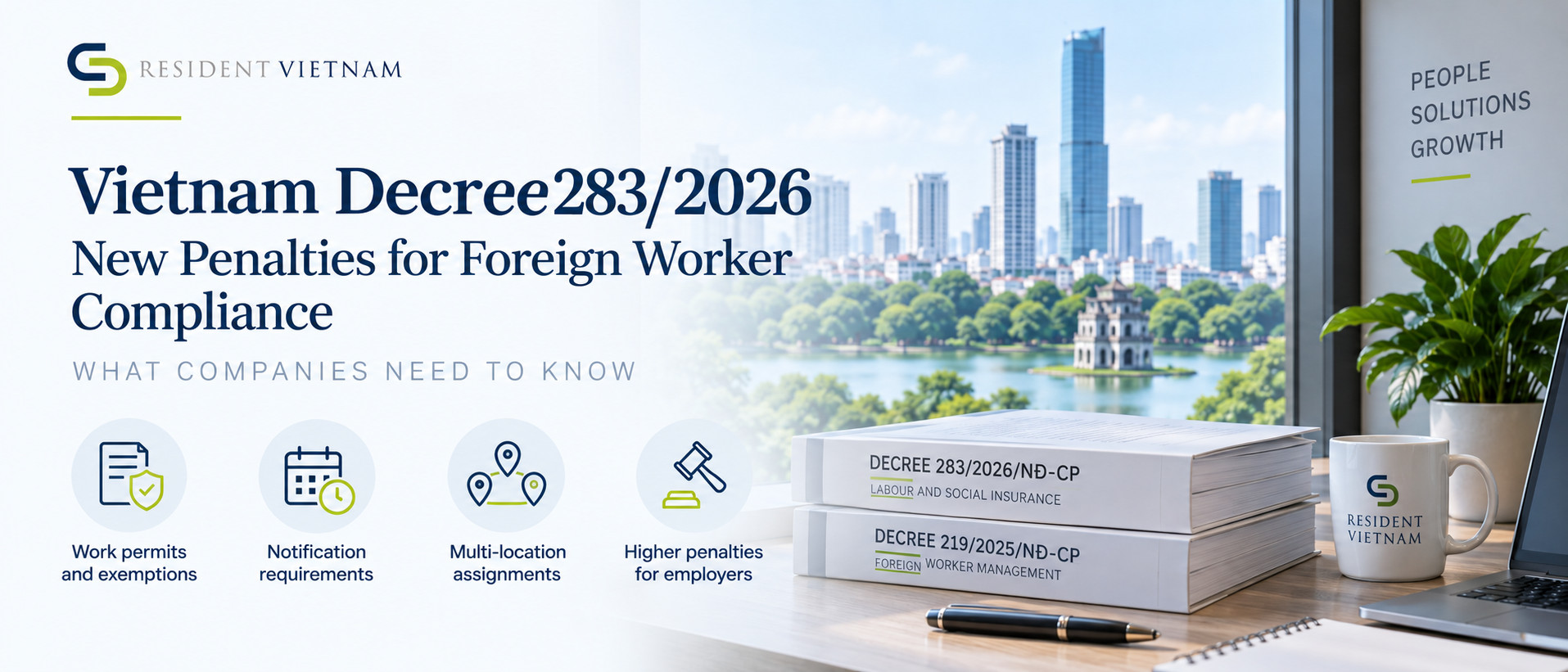
Vietnam’s new Decree 283/2026/NĐ-CP on administrative penalties in the fields of labour and social insurance takes effect on 10 September 2026, replacing Decree 12/2022/NĐ-CP. The new decree introduces an updated enforcement framework for companies employing or hosting foreign nationals in Vietnam.
Decree 283/2026/NĐ-CP brings Vietnam’s administrative penalty framework into line with the foreign-worker management regime introduced by Nghị định 219/2025/NĐ-CP, the current Work Permit Decree.
While the fundamental principles governing the employment of foreign nationals remain largely unchanged, Decree 283 expands the scope of enforceable compliance obligations introduced under Decree 219 and generally increases the level of penalties applicable to employers.
Importantly, foreign-worker compliance in Vietnam is increasingly about more than simply holding a valid Giấy phép lao động. Notification requirements, multi-location working arrangements and obligations at the end of an assignment are also becoming an integral part of the compliance framework.
Below, we look at the main provisions companies employing or hosting foreign nationals in Vietnam should be aware of.
Who Should Pay Attention to Decree 283/2026?
The new enforcement framework is particularly relevant to:
- Companies employing foreign nationals in Vietnam;
- Multinational companies sending employees to Vietnam for short-term assignments;
- Employers with foreign employees working across multiple provinces or centrally governed cities;
- Companies managing foreign specialists, technical experts or other international employees;
- HR and Global Mobility teams responsible for foreign-worker compliance;
- Companies managing the end of a foreign employee’s assignment in Vietnam.
The practical implications are especially important for employers that regularly manage international assignments, temporary projects or foreign employees working across different locations.
1. Working in Vietnam Without the Required Work Permit
A foreign employee may be subject to a fine of VND 15 million to VND 25 million if he or she:
- works in Vietnam without a Work Permit where one is required;
- works without a required Work Permit Exemption Certificate (WPEC); or
- continues working with an expired WP or WPEC.
In addition to the financial penalty, expulsion from Vietnam is provided as an additional sanction.
Employers are separately liable for employing foreign nationals without the required WP/WPEC or with an expired WP/WPEC.
The applicable employer penalties depend on the number of non-compliant foreign employees:
| Number of non-compliant foreign employees | Employer fine |
|---|---|
| 1–10 employees | VND 30–45 million |
| 11–20 employees | VND 45–60 million |
| 21 or more employees | VND 60–75 million |
For example, if a company employs one foreign national who is required to hold a Work Permit but does not have one, the employee may face a VND 15–25 million fine and expulsion, while the employer may separately face a VND 30–45 million fine.
This reinforces an important principle of Vietnam’s foreign-worker regime: both the foreign employee and the employer can face consequences when the required work authorisation is not in place.
For a broader overview of the authorization process, see our Vietnam Work Permit and Immigration Services page. Companies should also review the rules surrounding Work Permit Exemption Certificates where an exemption may apply.
2. What About the Work Notification Report for Assignments of Less Than 90 Days?
One of the most important practical changes concerns short-term foreign workers.
Under Decree 219/2025/NĐ-CP, certain foreign nationals working in Vietnam for a total period of less than 90 days in a calendar year may qualify for an exemption from the Work Permit requirement.
This category also does not require obtaining a Work Permit Exemption Certificate.
However, this does not mean that no labour compliance formalities are required.
Instead, the employer must notify the competent authority at least three working days before the foreign employee starts working in Vietnam.
Decree 283 now expressly introduces a penalty for failure to comply with this notification requirement.
An employer may face a fine of VND 1 million to VND 3 million for:
- failing to submit the required notification;
- submitting the notification late; or
- submitting an incomplete notification.
The employer may also be required to complete the notification as a remedial measure.
Does Failure to Notify Mean That the Foreign Employee Is Working Illegally?
This is an important distinction.
A foreign national who genuinely qualifies for the less-than-90-days-per-calendar-year exemption is legally exempt from both the Work Permit and WPEC requirements under Decree 219.
Mốc Work Notification Report is a separate employer compliance obligation.
Decree 283 reinforces this distinction by creating a specific employer penalty for failure to comply with the notification requirement rather than expressly treating the missing notification itself as employment without a WP/WPEC.
Therefore, based on our reading of the new regulations, where the foreign employee genuinely satisfies all the conditions of the applicable exemption, failure to submit the Work Notification Report may result in:
- a fine for the employer, together with an obligation to complete the required notification; but
- no specific penalty for the foreign employee solely because the employer failed to submit the notification.
This distinction is particularly relevant for multinational companies regularly sending employees to Vietnam for short-term projects, technical assignments, training or other temporary work activities.
Companies should nevertheless ensure that the foreign national genuinely satisfies the conditions of the exemption. The notification procedure should not be viewed as an alternative to obtaining a Work Permit where the employee does not qualify for the exemption.
3. Working in Multiple Provinces or Cities
Decree 219 introduced a more flexible framework allowing certain foreign employees to work for the same employer in multiple provinces or centrally governed cities, subject to notification requirements.
Decree 283 now provides an explicit penalty where the required notification is:
- not submitted;
- submitted late; or
- submitted incompletely.
The employer may face a fine of VND 1–3 million for failure to comply with the applicable multi-location notification requirement.
This is particularly relevant for foreign employees whose responsibilities require them to travel regularly between factories, project sites, branches or client locations in different provinces.
4. Employment Inconsistent with the WP or WPEC
Holding a valid Work Permit or WPEC does not, by itself, guarantee compliance.
An employer using a foreign employee in a manner inconsistent with the information stated on the WP/WPEC may face a fine of VND 5–10 million per employee, subject to a maximum of VND 75 million per employer.
Companies should therefore ensure that the employee’s actual working arrangements remain consistent with the authorisation obtained.
Changes to an employee’s role, work arrangements or other relevant circumstances should be reviewed from an immigration and labour compliance perspective rather than assuming that an existing Work Permit remains sufficient.
5. Compliance Obligations Continue at the End of an Assignment
Decree 283 also reinforces employers’ obligations relating to the retrieval, return and revocation of Work Permits and Work Permit Exemption Certificates.
This highlights an increasingly important feature of Vietnam’s foreign-worker management framework: compliance does not end when a Work Permit has been issued.
Employers need to manage the foreign employee’s immigration and labour compliance throughout the entire assignment lifecycle, including when the employment or assignment ends.
Practical Summary of Decree 283 Penalties
| Violation | Foreign employee | Employer |
|---|---|---|
| No WP/WPEC when required | VND 15–25m + expulsion | VND 30–45m for 1–10 employees; higher penalties for larger numbers of non-compliant employees |
| Expired WP/WPEC | VND 15–25m + expulsion | VND 30–45m for 1–10 employees; higher penalties for larger numbers of non-compliant employees |
| Employee qualifies for <90-day exemption but required notification was not submitted | No specific penalty identified solely for the missing notification | VND 1–3m |
| Notification submitted late or incompletely | — | VND 1–3m |
| Employment inconsistent with WP/WPEC information | — | VND 5–10m per employee, subject to the applicable cap |
| Required multi-province notification missing, late or incomplete | — | VND 1–3m |
What Does Decree 283 Mean for Employers in Vietnam?
The key message from Decree 283 is that foreign-worker compliance in Vietnam should no longer be viewed simply as a question of whether a foreign employee holds a valid Work Permit.
Together, Decree 219 and Decree 283 reinforce a broader framework based on work authorisation, notification and ongoing compliance.
This is particularly important for companies using foreign nationals for short-term assignments. While an employee may legitimately qualify for an exemption from both the Work Permit and WPEC requirements, the employer may still have a mandatory notification obligation.
Companies employing or hosting foreign nationals in Vietnam should therefore ensure that:
- each foreign employee holds the appropriate work authorisation or genuinely qualifies for an exemption;
- applicable Work Notification Reports are submitted correctly and on time;
- multi-province working arrangements are properly notified;
- actual working arrangements remain consistent with the WP/WPEC; and
- end-of-assignment WP/WPEC obligations are properly managed.
For a broader view of employer responsibilities, risks and compliance processes, read our guide to Tuân thủ quy định nhập cư tại Việt Nam: Những điều các công ty cần biết.
Frequently Asked Questions About Decree 283/2026
What is Decree 283/2026 in Vietnam?
Decree 283/2026/NĐ-CP establishes an updated framework for administrative penalties in the fields of labour and social insurance. It takes effect on 10 September 2026 and replaces Decree 12/2022/NĐ-CP.
When does Decree 283/2026 take effect?
Decree 283/2026/NĐ-CP takes effect on 10 September 2026.
What is the penalty for employing a foreign worker without a Work Permit?
A foreign employee may face a fine of VND 15 million to VND 25 million and expulsion from Vietnam. The employer may separately face a fine ranging from VND 30 million to VND 75 million, depending on the number of non-compliant foreign employees.
Can a foreign employee work in Vietnam for less than 90 days without a Work Permit?
Certain foreign nationals working in Vietnam for a total period of less than 90 days in a calendar year may qualify for an exemption from the Work Permit requirement under Decree 219/2025/NĐ-CP. However, the employer may still be required to submit a Work Notification Report at least three working days before the employee starts working.
Is a notification required for foreign workers who are exempt from a Work Permit?
For the specific less-than-90-days exemption discussed above, the employer must notify the competent authority at least three working days before the foreign employee starts working. Failure to submit, late submission or incomplete submission may result in an employer fine of VND 1 million to VND 3 million.
Can foreign employees work in multiple provinces in Vietnam?
Certain foreign employees may work for the same employer in multiple provinces or centrally governed cities, subject to applicable notification requirements. Failure to submit, late submission or incomplete submission of the required notification may result in an employer fine of VND 1 million to VND 3 million.
What happens if an employee’s actual work differs from the Work Permit?
An employer using a foreign employee in a manner inconsistent with the information stated on the Work Permit or WPEC may face a fine of VND 5 million to VND 10 million per employee, subject to a maximum of VND 75 million per employer.
Do employer obligations continue after a foreign employee leaves Vietnam?
Yes. Decree 283 reinforces obligations relating to the retrieval, return and revocation of Work Permits and Work Permit Exemption Certificates at the end of an assignment.
Resident Vietnam: Foreign Worker Compliance Support

Resident Vietnam assists companies with Work Permits, Work Permit exemptions, short-term work notifications and immigration compliance throughout Vietnam.
Our team supports international companies, HR teams and employers managing foreign employees across the full assignment lifecycle, from work authorization and immigration procedures to ongoing compliance requirements.
Should you have questions regarding Decree 283/2026/NĐ-CP, Decree 219/2025/NĐ-CP, or the compliance requirements applicable to your foreign employees in Vietnam, contact Resident Vietnam.