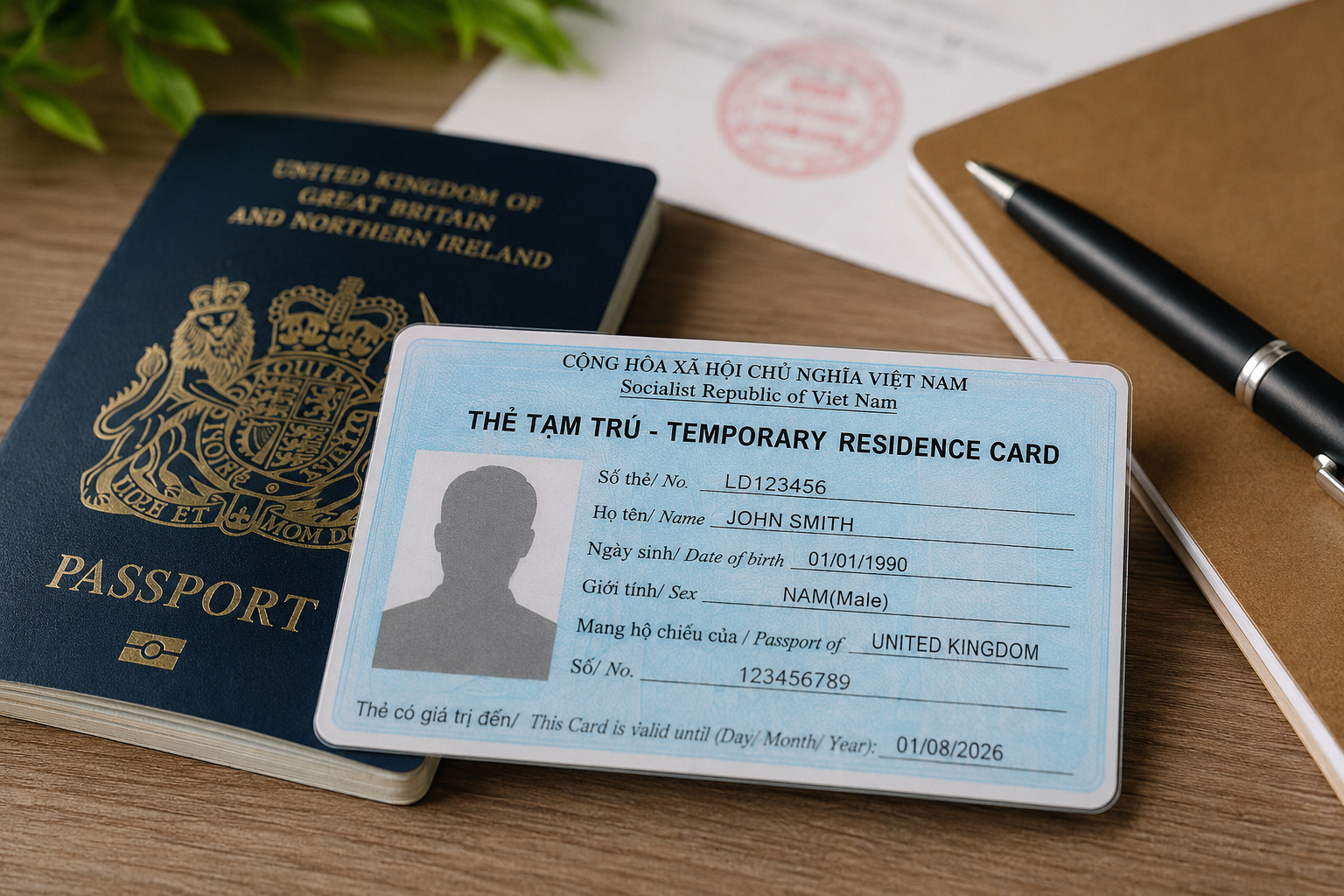
Vietnam has become one of Southeast Asia’s most attractive destinations for foreign professionals, investors, and international companies. While many newcomers initially enter the country using a e-visa or Business visa sponsored by their host entity, those planning a longer assignment often quickly discover another essential document: the Temporary Residence Card (TRC).
A Vietnam Temporary Residence Card is far more than an administrative convenience. It serves as a long-term residence permit that allows eligible foreigners to live in Vietnam without repeatedly applying for visas or managing frequent extensions.
Yet, despite its importance, the TRC process is often misunderstood. Questions frequently arise, such as:
- What is the difference between a visa and a Temporary Residence Card (TRC) in Vietnam?
- Who is eligible to obtain a Vietnam Temporary Residence Card?
- How long is a Vietnam TRC valid?
- What documents are required to apply for a Temporary Residence Card?
- How much does a Vietnam TRC cost?
- How long does the application process take?
- Is the foreign applicant required to collect the TRC in person?
- What happens if a Temporary Residence Card expires?
- Which procedures in Vietnam typically require a TRC?
- How does a TRC affect employers and corporate compliance obligations?
At Resident Vietnam, we regularly assist foreign professionals, investors, and businesses in navigating Vietnam’s immigration framework. Understanding how the TRC system works can significantly reduce administrative challenges and help ensure a smoother long-term stay in Vietnam.
What Is a Temporary Residence Card (TRC) in Vietnam?
A Temporary Residence Card (TRC) is an official residence permit issued by Vietnamese immigration authorities that allows eligible foreign nationals to legally reside in Vietnam for an extended period without needing to obtain multiple-entry visas.
The TRC functions as both:
- A residence permit;
- A multiple-entry document allowing re-entry into Vietnam during its validity period.
For foreigners planning to remain in Vietnam for several years, the TRC often becomes one of the most important immigration documents they will need to apply for.
Visa vs Temporary Residence Card: What’s the Difference?
Many foreigners confuse visas and Temporary Residence Cards because both permit entry and stay in Vietnam. However, they serve different purposes.
- Visa: A visa authorizes a foreign national to enter and remain in Vietnam for a specified period. Depending on the category, visas may require extensions or renewals if the foreign national remains in the country long-term. Visas are valid for a duration of up to 2 years renewable (if eligible)
- Temporary Residence Card: A TRC allows eligible foreigners to reside in Vietnam continuously during its validity period and eliminates the need for repeated visa applications or extensions. A TRC is generally valid for a period from one year to 3 years depending on the status and for those holding a work permit, the TRC duration will be aligned with the work permit..
In practice, obtaining a TRC usually provides greater convenience for long-term assignments, family relocations, and investment projects.
Who Can Apply for a Vietnam TRC?
Eligibility depends on the individual’s immigration status and relationship with Vietnam.
Common categories that may qualify include:
1. Foreign Employees
Foreign nationals holding valid work authorization sponsored by a Vietnamese registered entity may become eligible for a Temporary Residence Card.
2. Foreign Investors
Investors and capital-contributing members of Vietnamese enterprises may qualify for a TRC depending on their investment structure and legal position.
3. Family Members
Spouses and children of eligible foreign employees or investors may qualify for dependent Temporary Residence Cards.
4. Certain Special Categories
Some foreign representatives, international organization personnel, and individuals covered under specific legal arrangements may also qualify.
Because eligibility rules vary significantly depending on the situation, each case should be reviewed individually.
How Long Is a Vietnam Temporary Residence Card Valid? The Different Types of TRCs.
The validity period depends on the applicant’s immigration category and supporting documentation.
The duration of a TRC can be influenced by factors such as:
- Passport validity;
- Work permit duration;
- Investment status;
- Immigration category;
| TRC Type | Maximum Validity | Who Is Eligible? | Main Conditions |
| DT1 | Up to 10 years | Major foreign investors in Vietnam | Generally reserved for investors contributing VND 100 billion or more, or investing in sectors and geographical areas benefiting from special investment incentives. |
| DT2 | Up to 5 years | Medium-sized foreign investors | Usually applicable to investors contributing between VND 50 billion and under VND 100 billion, or investors operating in priority development sectors. |
| DT3 | Up to 3 years | Standard foreign investors | Generally issued to investors contributing between VND 3 billion and under VND 50 billion. |
| DT4 | No TRC. Vias up to 12 month available | Small-scale investors | Typically available to investors contributing less than VND 3 billion. |
| LD1 | Up to 2 years | Foreign work permit holders and certain work permit exemption holders | The applicant must generally hold a valid work permit or qualifying work permit exemption and be sponsored by a Vietnamese employer. The TRC duration usually cannot exceed the work authorization period. |
| TT | Up to 3 years | Dependents of eligible foreigners or Vietnamese citizens | Available to spouses and children under 18 of eligible foreign TRC holders, as well as foreign spouses, parents, and children of Vietnamese citizens. Proof of family relationship is required. |
| NN1 / NN2 | Up to 3 years | Chief representatives and heads of representative offices, NGOs, and international organizations | Requires appointment to a qualifying representative position and sponsorship by the organization operating in Vietnam. |
| LV1 / LV2, LS, DH | Up to 5 years | Certain officials, lawyers, and foreign students | Available only to specific categories recognized under Vietnamese immigration law and subject to documentary requirements. |
Practical Examples
- A foreign employee holding a two years work permit and a passport valid for more than 2 years may receive an LD TRC valid for up to two years.
- An investor eligible for a DT2 TRC but whose passport expires in 18 months will generally receive a TRC limited to approximately 17 months, since the card must expire at least 30 days before the passport.
- A foreign spouse of a Vietnamese citizen may obtain a TT TRC valid for up to three years, provided the passport has sufficient remaining validity and the family relationship documents are properly legalized and translated where required.
Why Passport Validity Matters
One of the most common mistakes is overlooking passport expiration dates.
A passport nearing expiration can create multiple issues:
- Shorter TRC validity or even only visa available;
- Additional immigration procedures;
- Increased administrative costs;
- Multiple document updates.
Many companies therefore encourage employees to renew their passports before beginning the immigration process to maximize the potential duration of the Temporary Residence Card.
Benefits of Holding a Vietnam TRC
A Temporary Residence Card offers several practical advantages for foreigners living in Vietnam.
- Greater Immigration Stability: TRC holders generally avoid frequent visa extensions and can remain in Vietnam continuously during the card’s validity period.
- Multiple Entries: TRC holders may leave and re-enter Vietnam without obtaining new visas each time, provided the card remains valid.
- Easier Daily Administration: Long-term residents often find that holding a TRC facilitates various administrative procedures and provides greater stability when establishing life in Vietnam.
- Better Long-Term Planning: For employers and expatriates alike, a TRC simplifies workforce planning and reduces uncertainty regarding immigration status.
- Ability to Obtain a VNeID: As Vietnam continues its digital transformation, holding a TRC often facilitates obtaining a personal VNeID account and accessing various online administrative services.
- Easier Banking and Financial Services: Many banks prefer or require a TRC for opening certain accounts, obtaining debit cards, applying for credit facilities, completing KYC procedures.
- Driver’s Licence Applications: Foreign residents usually need a TRC or equivalent long-term residence document when applying for or converting a Vietnamese driving licence.
Can a Vietnam TRC Be Renewed?
A Temporary Residence Card is not automatically renewed.
When a card approaches expiration, the sponsoring organization usually needs to coordinate the renewal process and ensure that all supporting conditions continue to be satisfied.
Depending on the situation, renewal may require updated documents such as:
- Valid passport;
- Updated work authorization;
- Current employment information;
- Supporting corporate documents;
- Additional immigration documentation.
⚠️Early preparation is highly recommended to avoid disruptions.
Risks of an Expired TRC
Allowing a Temporary Residence Card (TRC) to expire is not simply an administrative oversight. Once a TRC expires, the foreign national generally loses their lawful residence status in Vietnam and is considered to be overstaying their permitted period of stay.
Vietnam imposes administrative penalties depending on the length of the overstay:
| Period of Overstay | Administrative Fine |
| 1–15 days | VND 500,000 – VND 2,000,000 |
| 16–29 days | VND 3,000,000 – VND 5,000,000 |
| 30–59 days | VND 5,000,000 – VND 10,000,000 |
| 60–89 days | VND 10,000,000 – VND 15,000,000 |
| 90 days or more | VND 15,000,000 – VND 20,000,000 |
In more serious cases, immigration authorities may also impose additional measures, including:
- Mandatory exit from Vietnam;
- Deportation procedures;
- Temporary entry bans;
- Difficulties obtaining future visas, TRCs, or immigration approvals.
For foreign employees, an expired TRC can also create practical complications that extend beyond immigration penalties. These may include:
- Interruption of employment arrangements
- Inability to travel internationally and re-enter Vietnam
- Difficulties completing administrative procedures
- Compliance risks for the sponsoring employer.
⚠️Because immigration processing timelines can sometimes be unpredictable, companies should monitor expiration dates carefully and ideally begin preparing renewal applications several weeks before the TRC expiry date rather than waiting until the last moment.
Why Immigration Planning Should Start Early
A successful long-term assignment in Vietnam generally requires coordination between:
- Human resources teams;
- Legal departments;
- Foreign employees;
- Immigration specialists;
- Vietnamese authorities.
Early preparation allows companies to:
- Reduce compliance risks;
- Better manage employee relocation;
- Coordinate housing and settling-in arrangements;
- Minimize administrative delays;
- Improve the overall employee and dependent(s) experience.
Documents Required for a Vietnam Temporary Residence Card
The exact document checklist depends on the applicant’s immigration category. However, most applications generally require:
Documents Required from the Foreign Applicant
- Original passport with sufficient remaining validity;
- Passport-size photographs meeting immigration specifications;
- Temporary residence declaration issued by the local police registration system;
- Supporting documents proving eligibility for the relevant TRC category.
Documents Required from the Sponsoring Company
- Certified copies of the company’s registration documents;
- Application forms issued by the Immigration Department;
- Company introduction letter and authorized signatory documents;
- Registration of the company’s immigration seal and signature if required.
Additional Documents Depending on the TRC Category
| TRC Category | Eligible Applicants | Main Supporting Documents |
| LD – Foreign Employees | Foreign employees holding a work permit or a qualifying work permit exemption | • Valid Work Permit or Work Permit Exemption Certificate (WPEC) • Employer sponsorship documents• Employment contract, assignment letter, or appointment decision (where applicable) • Company registration documents and immigration registration records |
| DT1 / DT2 / DT3 / DT4 – Foreign Investors | Foreign investors and capital-contributing members of Vietnamese companies | • Investment Registration Certificate (IRC) where applicable • Enterprise Registration Certificate (ERC) • Documents evidencing the investor’s ownership status and capital contribution • Company registration documents and immigration registration records |
| TT – Dependents | Spouses and children of eligible foreign nationals or Vietnamese citizens | • Marriage certificate (for spouses) • Birth certificate (for children) • Legalized and translated family relationship documents where required• Copy of the sponsor’s passport and valid visa or TRC • Documents proving the sponsor’s lawful residence status in Vietnam |
| NN1 / NN2 – Representative Offices and NGOs | Chief representatives and heads of representative offices, foreign NGOs, and international organizations | • Appointment decision or authorization letter • Representative office license or NGO registration certificate • Organization sponsorship documents • Immigration registration records |
| LV1 / LV2, LS, DH – Special Categories | Certain officials, lawyers, and foreign students | • Documents proving the applicant’s specific status (practicing certificate, appointment decision, university enrollment documents, etc.) • Sponsorship documents from the relevant organization or institution |
⚠️ Documents issued overseas, such as marriage certificates, birth certificates, or appointment documents, generally need to be legalized where applicable, translated into Vietnamese, and notarized before being accepted by Vietnamese immigration authorities.
⚠️Depending on the applicant’s nationality, immigration history, and category, authorities may request additional supporting documentation.
How to Apply for a Vietnam Temporary Residence Card
Although procedures vary slightly depending on the category and locality, the process generally follows the same sequence.
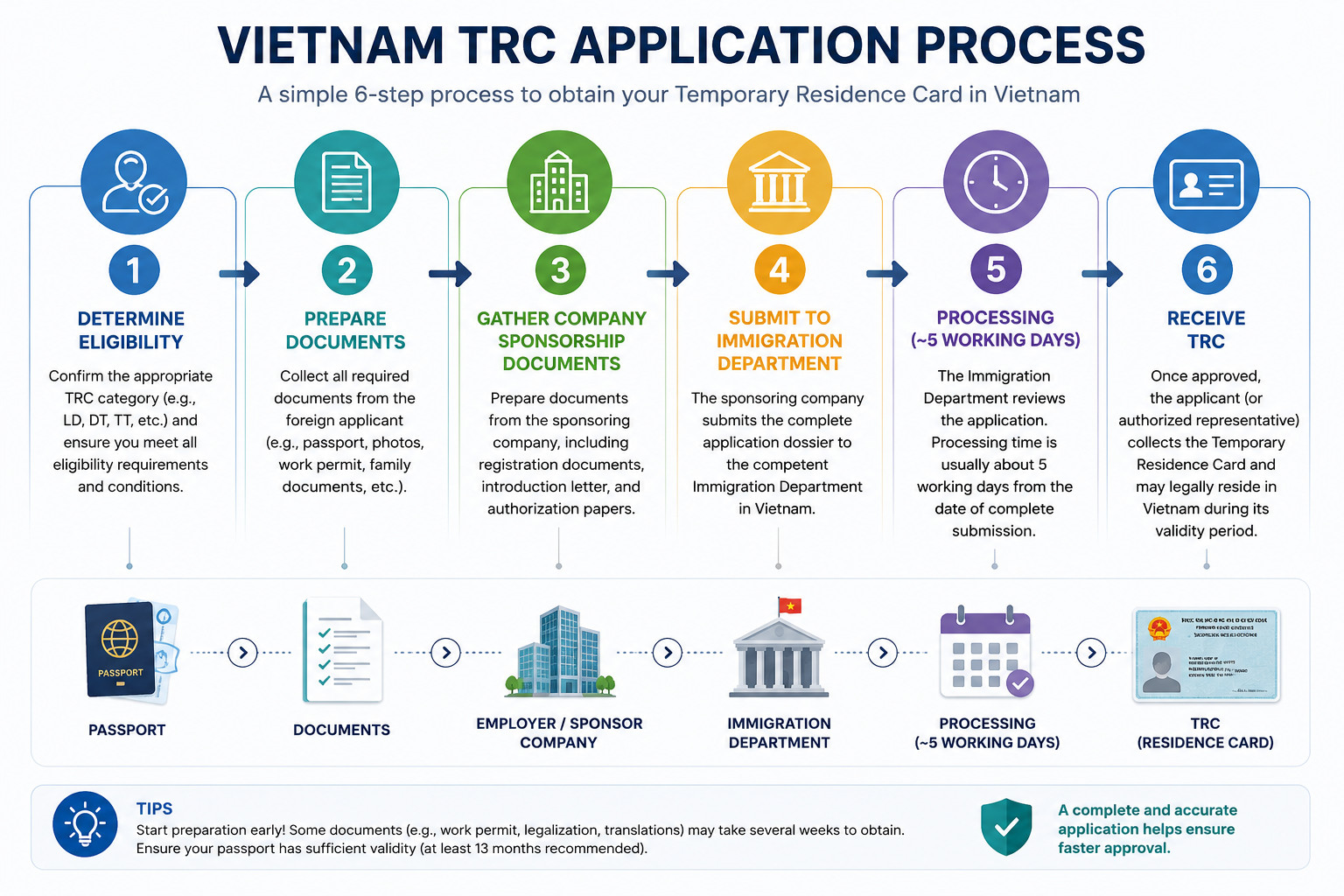
Step 1 – Determine Eligibility
Confirm the appropriate TRC category (LD, DT, TT, etc.) and ensure that the applicant meets all underlying requirements, including the right immigration status and supporting conditions.
Step 2 – Prepare Personal Supporting Documents
Collect all documents required from the foreign applicant, including the passport, photographs, and any documents proving eligibility for the relevant TRC category.
Particular attention should be given to:
- Passport validity;
- Validity of work permits or Work Permit Exemption Certificates where applicable;
- Legalization, Apostille, and translation requirements;
- Family relationship documents for dependent applications.
Step 3 – Gather Company Sponsorship Documents
The sponsoring organization must prepare the documents required to support the application, which may include:
- Company registration documents;
- Immigration application forms;
- Authorized signatory documents;
- Company introduction letters and immigration registration records.
Step 4 – Submit the Application to the Immigration Department
The sponsoring organization submits the complete application dossier to the competent Immigration Department first online and later offline with all supporting documents.
The foreign national cannot apply independently and must be sponsored by the qualifying company or organization or a spouse.
Step 5 – Immigration Review and Processing
The Immigration Department reviews the application and may request clarification or additional documents if necessary.
In straightforward cases, the official processing time is generally approximately 7 to 10 working days from the date a complete and valid application is accepted.
Step 6 – Receive the Temporary Residence Card
Once approved, the Temporary Residence Card is issued and may generally be collected by an authorized employee of the sponsoring company, or the applicant, depending on the circumstances.
The foreign national may then legally reside in Vietnam throughout the validity period of the TRC, provided that the conditions supporting the card continue to be satisfied.
How Much Does a Vietnam Temporary Residence Card Cost?
The official government fees for a Vietnam Temporary Residence Card (TRC) depend on the validity period of the card. As of June 2026, the applicable fees are as follows:
| TRC Validity | Government Fee |
| Up to 2 years | USD 145 per card |
| More than 2 years up to 5 years | USD 155 per card |
| More than 5 years up to 10 years | USD 165 per card |
These government fees only cover the issuance of the Temporary Residence Card itself. Depending on the case, applicants may incur additional costs, including:
- Document translation and notarization;
- Legalization of foreign documents where applicable;
- Work permit or work permit exemption procedures;
- Immigration advisory or relocation service fees.
⚠️ In practice, the government fee often represents only a small portion of the overall cost of obtaining a TRC. Translation, legalization, work authorization procedures and immigration advisory services may significantly increase the total budget depending on the applicant’s circumstances.
Other Concerns About Vietnam Temporary Residence Cards (TRC)
Is the applicant required to collect their TRC in person?
No.
In practice, the TRC is often collected by an authorized employee of the sponsoring company, , or an immigration service provider acting on behalf of the applicant. The foreign national is generally not required to appear in person solely to retrieve the card.
However, immigration procedures have become increasingly digitalized and practices may vary depending on the Immigration Department and the applicant’s specific circumstances. Companies should therefore verify the latest collection requirements before submission.
Can I apply for a TRC from Abroad?
No. A Temporary Residence Card is issued only after the foreign national has entered Vietnam under an appropriate immigration status and the supporting conditions for the TRC category have been met.
Most applicants therefore begin preparations abroad but complete the application process while physically present in Vietnam.
How long does it take to obtain a Vietnam TRC?
Under current regulations, the official processing time is generally 5 working days from the date the Immigration Department receives a complete and valid application dossier. However expect a few more days for processing.
⚠️Foreign employees should also factor in the time required to obtain a work permit, legalize foreign documents, and complete visa conversion procedures where necessary.
For what reasons TRC Applications can be delayed or rejected?
- Insufficient passport validity
- Expired work permit
- Missing legalization
- Missing or Incorrect Vietnamese translations
- Incomplete family relationship documents
- Incorrect investment documentation
- Employer registration inconsistencies
- Failure to maintain underlying immigration status
Repatriation and Temporary Residence Cards (TRC) termination
When a foreign employee’s assignment in Vietnam comes to an end, many companies focus primarily on payroll, tax finalization, and relocation arrangements. However, immigration compliance is equally important. Employers should be aware that a Temporary Residence Card (TRC) cannot simply be left to expire naturally if the purpose for which it was issued is no longer valid.
Failure to properly terminate a TRC and arrange the employee’s departure status may result in immigration compliance issues for both the sponsoring entity and the foreign national.
When Must a TRC Be Terminated?
A Temporary Residence Card is issued based on a specific immigration purpose, such as employment, investment, family dependency, or representation of a foreign organization.
For foreign employees, an LĐ TRC is typically sponsored by the employer and supported by a valid work permit or work permit exemption certificate.
Once the underlying purpose ceases to exist, the TRC is no longer considered valid for its intended purpose. Common situations include:
- Resignation or termination of employment;
- Completion of an assignment or project in Vietnam;
- Internal transfer to another legal entity;
- Closure of a representative office or business operation;
- Cancellation or expiry of the underlying work authorization.
In such cases, the sponsoring entity is responsible for notifying the relevant immigration authorities and carrying out the TRC cancellation procedure.
Why Is TRC Cancellation Important?
Many foreign employees mistakenly believe they can continue using a valid TRC until its printed expiry date, even after their employment has ended.
However, a TRC is tied to the purpose under which it was granted. Once the sponsoring relationship ends, the card should be formally terminated.
Employers that fail to comply with immigration obligations may face scrutiny during future immigration applications, audits, or inspections.
Exit Visa Requirement Following TRC Termination
A point frequently overlooked during repatriation is that a foreign national whose TRC has been cancelled cannot simply depart Vietnam using the cancelled card.
After TRC cancellation, the foreign national must obtain an appropriate visa to remain in Vietnam until departure. In practice, this is commonly referred to as an “exit visa.”
The exit visa allows the foreign national to:
- Remain legally in Vietnam following TRC cancellation;
- Complete handover activities;
- Finalize personal affairs such as housing, banking, schooling, and shipment arrangements;
- Depart Vietnam within the authorized validity period.
The validity period granted may vary depending on the circumstances and the immigration authority’s assessment.
Recommended Timeline for Repatriation Cases
To avoid last-minute complications, employers should begin immigration planning several weeks before the employee’s final working day.
A typical process may include:
Step 1: Confirm Employment End Date
Determine the employee’s last working day and intended departure date from Vietnam.
Step 2: Cancel Work Authorization
Where required, cancel the work permit or work permit exemption certificate.
Step 3: Cancel the TRC
Submit the TRC cancellation application to the immigration authorities.
Step 4: Obtain an Exit Visa
Apply for an appropriate visa allowing the employee to remain legally in Vietnam until departure.
Step 5: Exit Vietnam
The foreign national departs Vietnam before the expiry of the exit visa.
Special Considerations
The process may vary depending on the individual’s circumstances. Additional planning may be required where:
- The employee intends to remain in Vietnam under a different sponsoring entity;
- Dependents hold TT TRCs linked to the principal holder;
- The foreign national intends to convert to an investor, spouse, or other immigration category;
- Multiple permits, representative office appointments, or corporate positions are involved.
Each case should be reviewed individually to determine the most appropriate immigration strategy.
Conclusion
Proper immigration closure is an essential component of any repatriation process. Employers should ensure that Temporary Residence Cards are formally terminated when the underlying purpose is no longer valid and that affected foreign nationals obtain the necessary exit visa before departing Vietnam.
Early planning helps avoid compliance issues, prevents disruption to departure arrangements, and ensures a smooth transition for both the employee and the sponsoring organization.
For assistance with TRC cancellation, work permit cancellation, exit visa applications, or repatriation planning in Vietnam, please contact Resident Vietnam.
Need Help Obtaining a Vietnam Temporary Residence Card?
Every TRC application is different. Eligibility rules, supporting documents, work authorization requirements and recent digitalization initiatives can significantly affect timelines and outcomes.
Resident Vietnam assists foreign employees, investors and families throughout the entire process, from eligibility assessment and document preparation to immigration procedures and long-term settlement support.