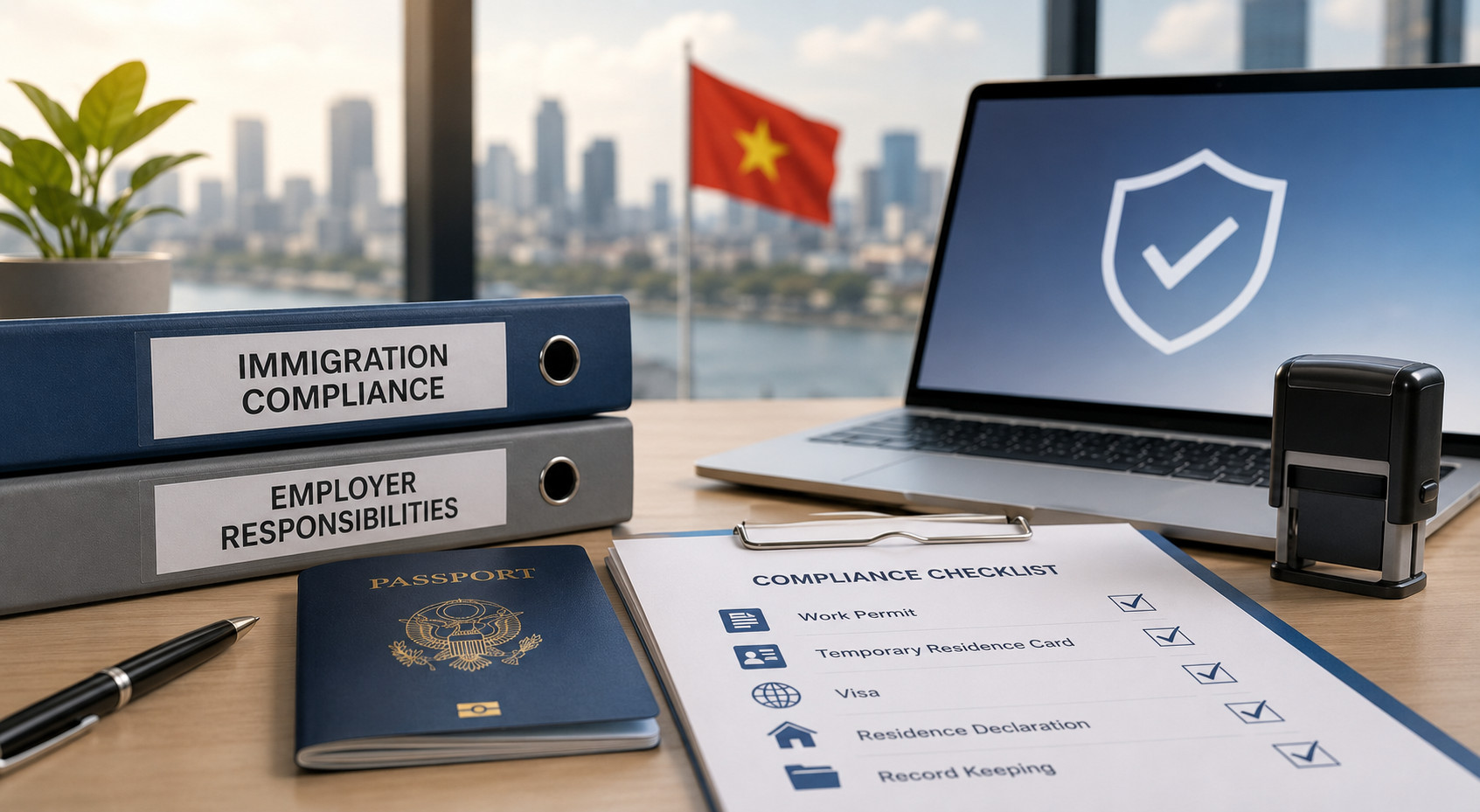
Vietnam has become one of Southeast Asia’s leading destinations for foreign investment and international talent. Every year, thousands of foreign professionals relocate to Vietnam to work, invest, or manage regional operations. However, employing foreign nationals in Vietnam involves much more than obtaining a visa or securing a work permit.
Vietnam’s immigration framework is undergoing continuous and significant transformation.
Over recent years, authorities have introduced successive reforms affecting immigration procedures, labour regulations, digital identification systems, and online public services.
At the same time, administrative procedures are becoming increasingly interconnected, with immigration, labour, taxes, business registration, and digital government platforms sharing information more closely than ever before.
As a result, the compliance landscape for companies employing foreign nationals is evolving rapidly.
Requirements relating to visas, work permits, Temporary Residence Cards (TRCs), residence declarations, and digital identification systems such as VNeID increasingly operate as part of a broader, integrated compliance ecosystem that employers must actively monitor and manage.
Many companies only discover the extent of these obligations when facing application delays, administrative penalties, compliance inspections, or disruptions to their foreign employees’ assignments.
Common questions include:
- What are an employer’s immigration responsibilities in Vietnam?
- Which immigration procedures are companies required to manage for foreign employees?
- What are the most common immigration compliance violations in Vietnam?
- What penalties can companies face for non-compliance?
- How do immigration authorities conduct inspections and audits?
- Can foreign employees start working before obtaining the proper authorization?
- How do work permits, visas, and Temporary Residence Cards interact?
- What records should companies maintain for immigration compliance purposes?
- How are recent digitalisation initiatives changing immigration procedures?
- Why do many companies outsource immigration management in Vietnam?
At Resident Vietnam, we regularly support foreign-invested companies, representative offices, investors, and international employees with immigration planning and compliance management.
This guide explains the key responsibilities of employers, common compliance risks, and practical strategies to help businesses manage foreign employees lawfully and efficiently in Vietnam.
Key Regulations Governing Immigration Compliance in Vietnam
Immigration compliance for foreign employees in Vietnam is primarily governed by:
- The Law on Entry, Exit, Transit and Residence of Foreigners in Vietnam (Law No. 47/2014/QH13, as amended);
- The Labour Code 2019 (Law No. 45/2019/QH14);
- Decree No. 219/2025/ND-CP dated 7 August 2025, governing foreign workers working in Vietnam which is expected to be amended very shortly.Various implementing regulations, ministerial guidance, and administrative procedures issued by the Ministry of Public Security and other competent provincial authorities.
These regulations continue to evolve as Vietnam accelerates its digital transformation and modernization of administrative procedures.
Understanding Immigration Compliance in Vietnam
Immigration compliance refers to the obligations imposed on companies that sponsor, employ, host, or relocate foreign nationals in Vietnam.
Compliance does not simply concern obtaining a work permit. It involves ensuring that the foreign employee’s immigration status remains lawful throughout the assignment and that all related procedures are properly coordinated and maintained.
A compliant assignment generally requires alignment between:
- Immigration status and visa category;
- Work authorization;
- Temporary residence status;
- Employer sponsorship obligations;
- Residence declarations;
- Record-keeping requirements;
- Digital administrative procedures.
Because these obligations often overlap, immigration compliance should be viewed as an ongoing process rather than a one-time application.
The Foreign Employee Compliance Lifecycle in Vietnam
For most companies, immigration compliance follows a continuous cycle:
🏢 Hire/assign Foreign Employee
↓
🛂 Appropriate Visa
↓
📄 Work Permit or Work Permit Exemption or work notification report
↓
🏠 Residence Declaration
↓
🪪 Temporary Residence Card (TRC)
↓
📅 Monitor Renewals and Material Changes
↓
✅ Ongoing Immigration Compliance
A delay or non-compliance at any stage can potentially affect the entire assignment.
Employer Responsibilities for Foreign Employees in Vietnam
The employer’s obligations regarding foreign employees primarily arise from the Labour Code and Decree No. 219/2025/ND-CP, as amended.
Companies sponsoring foreign nationals generally remain responsible for coordinating and monitoring various immigration procedures.
Typical responsibilities include:
- Determining whether a work permit or exemption is required;
- Coordinating work permit applications and renewals;
- Sponsoring visas and Temporary Residence Cards;
- Monitoring expiration dates;
- Reporting changes affecting immigration status;
- Maintaining supporting documentation;
- Ensuring foreign employees work only under authorized conditions;
- Assisting with residence declaration obligations where applicable.
Companies should also establish internal processes to monitor changes in assignment duration, job position, work location, passport validity, and corporate information, as these factors may directly affect immigration compliance.
Common Immigration Compliance Violations in Vietnam
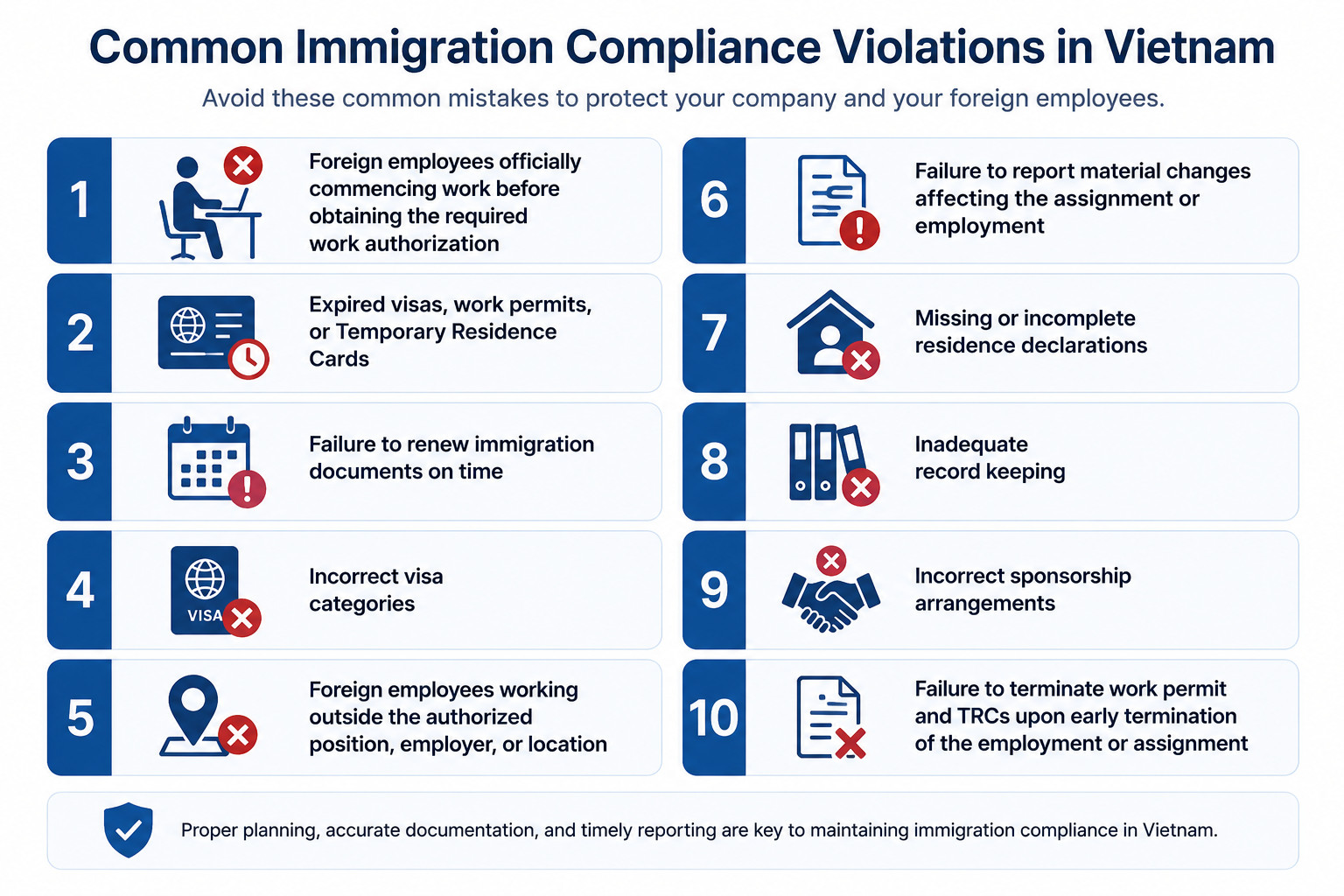
Many compliance issues arise not from deliberate misconduct but from administrative oversight, insufficient planning, or misunderstanding of local requirements.
Some of the most frequent violations include:
- Foreign employees officially commencing work before obtaining the required work authorization;
- Expired visas, work permits, or Temporary Residence Cards;
- Failure to renew immigration documents on time;
- Incorrect visa categories;
- Foreign employees working outside the authorized position, employer, or location;
- Failure to report material changes affecting the assignment or employment;
- Missing or incomplete residence declarations;
- Inadequate record keeping;
- Incorrect sponsorship arrangements;
- Failure to coordinate work permit and immigration timelines.
- Failure to terminate work permit and TRCs upon early termination of the employment of assingment
⚠️ Even seemingly minor administrative errors can create significant complications for both employers and employees.
Immigration Audits and Government Inspections
Vietnamese authorities increasingly exchange information between immigration, labour, tax, business registration, and digital administrative systems.
As a result, companies employing foreign nationals may be subject to inspections or requests for supporting documentation.
During an inspection, authorities may review:
- Work permits and exemptions;
- Temporary Residence Cards and visas;
- Employment contracts and assignment letters;
- Passport copies;
- Residence declarations;
- Corporate registration documents;
- Immigration sponsorship records;
- Supporting documents justifying the foreign employee’s position.
The increasing interconnection between government agencies significantly enhances authorities’ ability to cross-check information provided by sponsoring entities.
Companies should therefore maintain organized records and ensure that documentation remains consistent across all procedures.
Potential Consequences of Non-Compliance
Immigration non-compliance may expose both companies and foreign employees to administrative penalties and operational disruptions.
Potential consequences may include:
- Administrative fines;
- Rejection of immigration applications;
- Delays in work permit or TRC issuance;
- Difficulties obtaining renewals;
- Mandatory departure from Vietnam in serious cases;
- Business disruption and assignment delays;
- Increased scrutiny during future applications.
Beyond regulatory penalties, immigration issues can significantly disrupt business operations, onboarding schedules, project planning, and international mobility management.
Why Immigration Planning Matters
Successful international assignments require coordination between multiple stakeholders:
- Human Resources teams;
- Legal and compliance departments;
- Foreign employees;
- Management teams;
- Immigration specialists;
- Vietnamese authorities.
A proactive approach allows companies to:
- Reduce compliance risks;
- Avoid unnecessary delays;
- Improve employee experience;
- Facilitate international mobility;
- Better plan renewals and assignments;
- Minimize administrative burdens.
For companies managing multiple expatriates, immigration compliance should form part of a broader workforce management strategy rather than being handled on an ad hoc basis.
How Digital Transformation Is Changing Immigration Compliance

Vietnam’s digital transformation is fundamentally changing how companies interact with government authorities.
Over recent years, authorities have increasingly moved administrative procedures online and strengthened interconnectivity between government platforms. Work permit procedures, immigration applications, digital identification systems, and public service portals continue to evolve.
Recent developments surrounding Business VNeID have demonstrated how rapidly procedural requirements can change and how digital access can quickly become essential for companies managing immigration procedures.
As digitalisation progresses, companies should expect:
- Increased use of online administrative platforms;
- Greater interconnection between government databases;
- Faster verification of information;
- More extensive use of digital identities;
- Greater expectations regarding document accuracy and consistency.
Companies that adopt a proactive compliance strategy are generally better positioned to adapt to future regulatory changes.
Why Many Companies Outsource Immigration Management in Vietnam
Managing immigration procedures internally can quickly become resource-intensive, particularly for companies with limited experience in Vietnamese administrative procedures, where regulations continue to evolve and practices may vary from one province to another.
Many businesses choose to outsource immigration management because it provides:
- Specialized and updated knowledge of immigration procedures;
- Better monitoring of regulatory developments;
- Centralized document management;
- Improved deadline tracking;
- Reduced administrative burden on HR teams;
- Lower compliance risks;
- Faster coordination of immigration and relocation processes;
- A more predictable experience for foreign employees.
⚠️Outsourcing does not remove the employer’s legal responsibilities, but it often allows companies to manage those responsibilities more efficiently and reduce the risk of costly administrative errors.
FAQ on Immigration Compliance for Companies
Can a foreign employee start working before obtaining a work permit?
Generally, no when the work missions exceed 90 days per calendar year. Foreign employees should only commence work after obtaining the appropriate work authorization or confirming that they qualify for an applicable exemption. Starting work too early may expose both the employee and employer to administrative penalties and compliance risks.
Does hiring a foreign employee automatically give them the right to live and work in Vietnam?
No. Employment, immigration status, and work authorization are separate but interconnected requirements. Depending on the situation, a foreign employee may require a work permit or exemption, a relevant visa, or a Temporary Residence Card (TRC).
Is the employer responsible for immigration compliance?
Yes. Under Vietnamese regulations, the sponsoring organization plays a central role in managing work authorization and immigration procedures for foreign employees. Employers are responsible for coordinating applications, monitoring expiration dates, and ensuring that foreign employees work under lawful conditions. Without a Vietnamese registered entity sponsor, a foreign national cannot obtain a work authorization and related visa or TRC to work and stay in Vietnam.
What happens if a foreign employee changes position or work location?
Changes to an employee’s position, employer, work location, or assignment conditions may affect the validity of the underlying work authorization and immigration documents. Companies should review the employee’s immigration status before implementing material changes.
Can a company continue employing a foreign employee if their work permit or TRC expires?
Generally, no. Allowing a foreign employee to continue working with expired immigration or work authorization documents may expose both the employee and employer to compliance risks and administrative penalties. Renewal procedures should therefore be anticipated well in advance.
How long should companies keep immigration records?
As a best practice, companies should maintain organized records of visas, work permits, TRCs, employment documents, and supporting immigration applications throughout the employee’s assignment and for an appropriate period of few years thereafter. Proper record keeping can significantly facilitate inspections and renewal procedures.
Are companies likely to be audited by Vietnamese authorities?
Inspections are not limited to large corporations. Any company sponsoring foreign nationals may be requested to provide supporting documentation relating to work permits, immigration status, and employment arrangements. As government databases become increasingly interconnected, maintaining accurate and consistent records is becoming even more important.
What is the biggest immigration compliance mistake companies make in Vietnam?
The most common mistake is treating immigration compliance as a one-time application process. In reality, compliance is continuous and requires ongoing monitoring of visas, work permits, Temporary Residence Cards, passport validity, residence declarations, and any changes affecting the foreign employee’s assignment. Companies that adopt a proactive and structured approach generally experience fewer disruptions and lower compliance risks.
Final Thoughts

Immigration compliance in Vietnam extends far beyond obtaining a visa or work permit. It is an ongoing process requiring careful coordination between work authorization, immigration status, residence procedures, and employer obligations.
As Vietnam continues to modernize and digitalize administrative procedures, companies employing foreign nationals should adopt a proactive compliance strategy and monitor immigration obligations continuously rather than only when documents are due for renewal.
Whether you employ a single expatriate or manage an international workforce, proper immigration compliance planning can significantly reduce risks, avoid unnecessary disruptions, and support a smoother experience for both employers and foreign employees.