Do you need to use a foreign document in Vietnam?
Whether you are preparing a work permit application, an immigration procedure, a business filing, or another administrative process, the required document issued in a foreign country may need to be legalized, authenticated, notarized, translated, or apostilled before it can be accepted by a Vietnamese authority.
The correct procedure depends on several factors, including where the document was issued, what type of document it is, and for which procedure in Vietnam it will be used.
Since the Apostille Convention entered into force for Vietnam on 11 September 2026, some foreign public documents can now follow a simplified Apostille process instead of traditional consular legalization.
However, an Apostille does not automatically apply to every document or every country, and it does not replace all other administrative requirements.
This guide explains the difference between Apostille, consular legalization, authentication and notarization, how to legalize a foreign document for use in Vietnam, and what companies, foreign nationals and international professionals should prepare before submitting their documents.
What Does It Mean to Legalize a Foreign Document for Use in Vietnam?
When a foreign document is issued outside Vietnam and needs to be used in Vietnam, the Vietnamese authority receiving the document may require evidence that the document is authentic.
Traditionally, this has involved a process known as consular legalization. Depending on the country of origin, the document may first need to be authenticated by an authority in the country where it was issued and then legalized by a Vietnamese embassy or consulate.
Since Vietnam joined the Hague Apostille Convention, eligible public documents from countries with an applicable Apostille relationship with Vietnam can instead use an Apostille certificate.
The practical objective is the same: to provide a recognized mechanism for authenticating the origin of the document before it is used in Vietnam.
For an overview of Vietnam’s accession to the Apostille Convention and its impact on immigration and work permit procedures, see our guide to Vietnam’s Apostille Convention and Work Permit Applications.
Apostille vs. Legalization vs. Authentication vs. Notarization
These terms are often used interchangeably, but they refer to different procedures.
| Procedure | What it generally does | When it may be relevant |
| Apostille | Authenticates the origin of an eligible public document for use in another participating country | Where the Apostille Convention applies between the relevant countries |
| Consular legalization | Authenticates the signature, authority and seal on a foreign document through the applicable diplomatic or consular process | Where Apostille does not apply or where legalization remains required |
| Authentication | Certifies the authenticity of a signature, seal or official act at the relevant stage of the document process | Often part of the document certification process before it is used internationally |
| Notarization | Certifies a signature, copy, declaration or other notarial act | When required for the document, its copy, translation or supporting paperwork |
One of the most important distinctions is that Apostille and consular legalization are not the same procedure. The Apostille system is designed to replace consular legalization for eligible public documents when the Convention applies.
Likewise, notarization is not a substitute for an Apostille or legalization. A notarized document may still need to be authenticated or apostilled depending on its intended use.
Which Documents May Need Legalization in Vietnam?
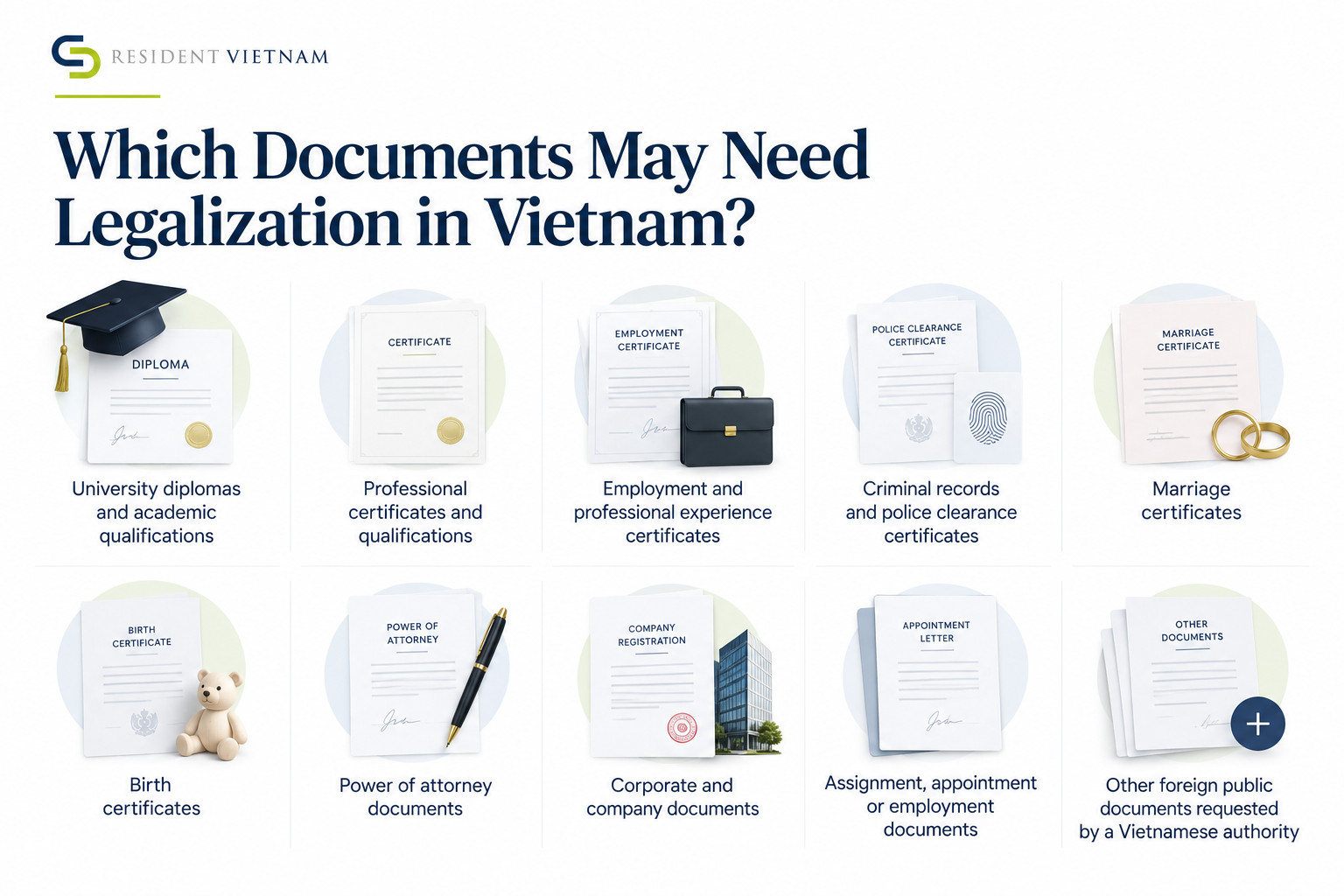
A wide range of foreign-issued documents may need authentication before they can be used for administrative or legal purposes in Vietnam.
Common examples include:
- University diplomas and academic qualifications;
- Professional certificates and qualifications;
- Employment and professional experience certificates;
- Criminal records and police clearance certificates;
- Marriage certificates;
- Birth certificates;
- Power of attorney documents;
- Corporate and company documents;
- Assignment, appointment or employment documents;
- Other foreign documents requested by a Vietnamese authority.
The exact procedure depends on the legal nature of the document. Not every document qualifies as a public document under the Apostille Convention, and certain documents may fall outside its scope.
Do You Need an Apostille or Consular Legalization?
The first question to ask is not whether you need an Apostille. It is whether the Apostille Convention applies to your specific document and country of origin.
Before starting the procedure, you should identify five key factors:
- What document is being used?
- Which country issued the document?
- Where will the document be used?
- Does the Apostille Convention apply between the two countries?
- Are there any additional requirements imposed by the Vietnamese authority receiving the document?
This is particularly important because a country being a contracting party to the Apostille Convention does not automatically mean that every document exchanged with Vietnam can use an Apostille.
Vietnam’s Apostille regime became effective on 11 September 2026, but the Convention only operates where the Convention is applicable between Vietnam and the country concerned.
How the Apostille Process Works for Foreign Documents
Where the Apostille Convention applies, the traditional multi-step legalization process can be replaced by an Apostille issued by the competent authority in the country where the public document originated.
The general process is:
- Obtain the original public document or the appropriate official document.
- Check whether the document is eligible for an Apostille.
- Request the Apostille from the competent authority in the issuing country.
- Check whether the receiving authority in Vietnam requires translation, notarization or other supporting documents.
- Submit the completed documentation to the relevant Vietnamese authority.
The exact process for obtaining an Apostille depends on the issuing country and the type of document.
For a detailed explanation of Vietnam’s accession, entry into force and the countries currently subject to objections, read our dedicated Vietnam Apostille Convention guide.
How Traditional Consular Legalization Works
When the Apostille Convention does not apply, the document may need to follow the traditional consular legalization process.
Although procedures vary between countries, a foreign document intended for use in Vietnam may typically go through several stages:
- Issuance of the original document by the relevant authority;
- Authentication or certification by the competent authority in the country of origin;
- Legalization by the relevant Vietnamese embassy or consulate;
- Translation into Vietnamese where required;
- Notarization or certification of the translation where required;
- Submission to the Vietnamese authority handling the underlying procedure.
The exact sequence depends on the country of origin, document type and applicable rules.
This is why companies and foreign professionals should determine the correct legalization route before sending documents for certification.
Do Foreign Documents Need to Be Translated into Vietnamese?
An Apostille or consular legalization does not eliminate translation requirements.
Where a Vietnamese authority requires the document to be submitted in Vietnamese, the foreign document still need to be translated and notarized according to the applicable procedure.
The translation requirement depends on the type of application and the authority receiving the document.
This means that obtaining an Apostille is only one part of the overall document preparation process.
Does Notarization Replace Legalization?
No.
Notarization and legalization serve different purposes.
A notary may certify a signature, a copy of a document, a declaration or another notarial act. Legalization or Apostille procedures are concerned with authenticating the origin of the document or the relevant official signature, authority and seal for international use.
For this reason, a document can sometimes require both notarization and Apostille or legalization, depending on how it was issued and how it will be used.
Using Foreign Documents for Vietnam Work Permit Applications
Foreign-issued documents are frequently required when a company prepares a Vietnam Work Permit application.
Depending on the employee’s situation, examples may include:
- University diplomas;
- Professional qualifications;
- Professional experience certificates;
- Criminal records or police clearance documents;
- Employment or assignment documentation;
- Other supporting documents requested as part of the application.
Where foreign documents must be legalized or apostilled, this step can significantly affect the overall preparation timeline.
For multinational companies relocating employees to Vietnam, it is therefore important to determine the document requirements early rather than waiting until the work permit application is ready to be submitted.
Using Foreign Documents for Immigration and Residence Procedures
Document authentication is not limited to Work Permit applications.
Foreign documents may also be required for:
- Temporary Residence Card procedures;
- Dependent and family immigration;
- Marriage-related procedures;
- Birth and family documentation;
- Other residence or immigration applications.
Where a foreign document is required, the appropriate authentication route should be established before the application is prepared.
For more information about Temporary Residence Cards, see our guide to Vietnam Residence Cards (TRC).
What Happens After Legalization or Apostille?
Obtaining an Apostille or completing consular legalization does not necessarily mean that the document is immediately ready for every procedure in Vietnam.
Depending on the application, you may still need to:
- Translate the document into Vietnamese;
- Have the translation notarized or certified;
- Provide additional supporting documents;
- Submit the document together with government forms;
- Meet specific requirements imposed by the receiving Vietnamese authority.
The Apostille confirms the authenticity of the document’s official origin. It does not certify the substantive content of the document and does not automatically guarantee acceptance for a particular administrative procedure.
Countries Where the Apostille Convention Does Not Apply to Vietnam
Vietnam’s accession to the Apostille Convention does not mean that all foreign documents can immediately use the Apostille process.
The Convention applies according to the specific relationship between Vietnam and the country concerned.
As of September 2026, Germany, Austria and the Czech Republic have objected to Vietnam’s accession. Documents exchanged between Vietnam and these countries therefore remain subject to the applicable traditional legalization process unless another legal arrangement applies.
Thailand is also not yet covered by the Apostille system for documents exchanged with Vietnam. Thailand acceded to the Convention on 30 June 2026, but the Convention will only enter into force for Thailand on 28 February 2027. Until then, documents exchanged between Thailand and Vietnam remain subject to the applicable traditional legalization process.
This is one of the reasons why companies should verify the applicable procedure based on the country of origin and intended use of the document before starting the process.
How Long Does Foreign Document Legalization Take?
Processing times vary significantly depending on the document, country of origin and authentication route but may take 1 to 2 months in some cases.
Where traditional legalization is required, the process may involve several different authorities and can take substantially longer than the final legalization step alone.
With an Apostille, the process may be simpler because the consular legalization stage is removed where the Convention applies. However, document issuance, authentication, translation and other supporting requirements can still affect the overall timeline.
Companies should therefore allow sufficient time for document preparation, particularly when the documents are required for a Work Permit, immigration or residence application.
Common Mistakes When Legalizing Documents for Vietnam
Several recurring mistakes can delay applications or lead to unnecessary costs.
- Using the wrong procedure: assuming that every foreign document can use an Apostille.
- Ignoring the country relationship: checking only whether a country is an Apostille member without verifying whether the Convention applies with Vietnam.
- Starting too late: waiting until the main immigration or work permit application is ready before preparing foreign documents.
- Confusing notarization and legalization: treating a notarized document as automatically valid for international use.
- Forgetting translation requirements: assuming an Apostille removes the need for Vietnamese translation.
- Submitting incomplete documents: failing to check the requirements of the authority receiving the final application.
A Practical Checklist for Foreign Document Legalization in Vietnam
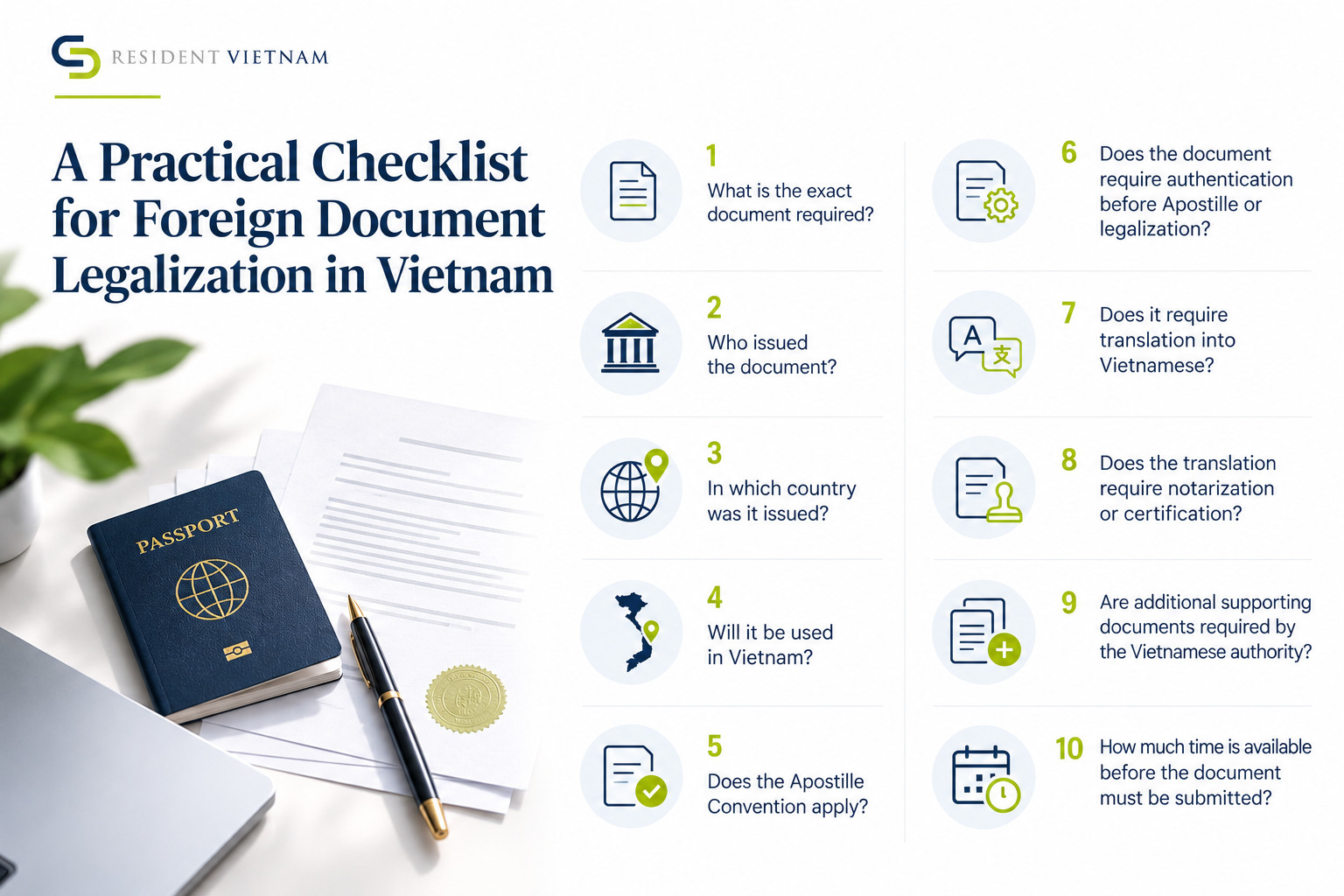
Before starting any legalization or Apostille procedure, companies and foreign professionals should check:
- What is the exact document required?
- Who issued the document?
- In which country was it issued?
- Will it be used in Vietnam?
- Does the Apostille Convention apply?
- Does the document require authentication before Apostille or legalization?
- Does it require translation into Vietnamese?
- Does the translation require notarization or certification?
- Are additional supporting documents required by the Vietnamese authority?
- How much time is available before the document must be submitted?
Checking these points before beginning the process can help avoid unnecessary legalization, translation and courier costs.
Which Countries Can Use the Apostille System With Vietnam?
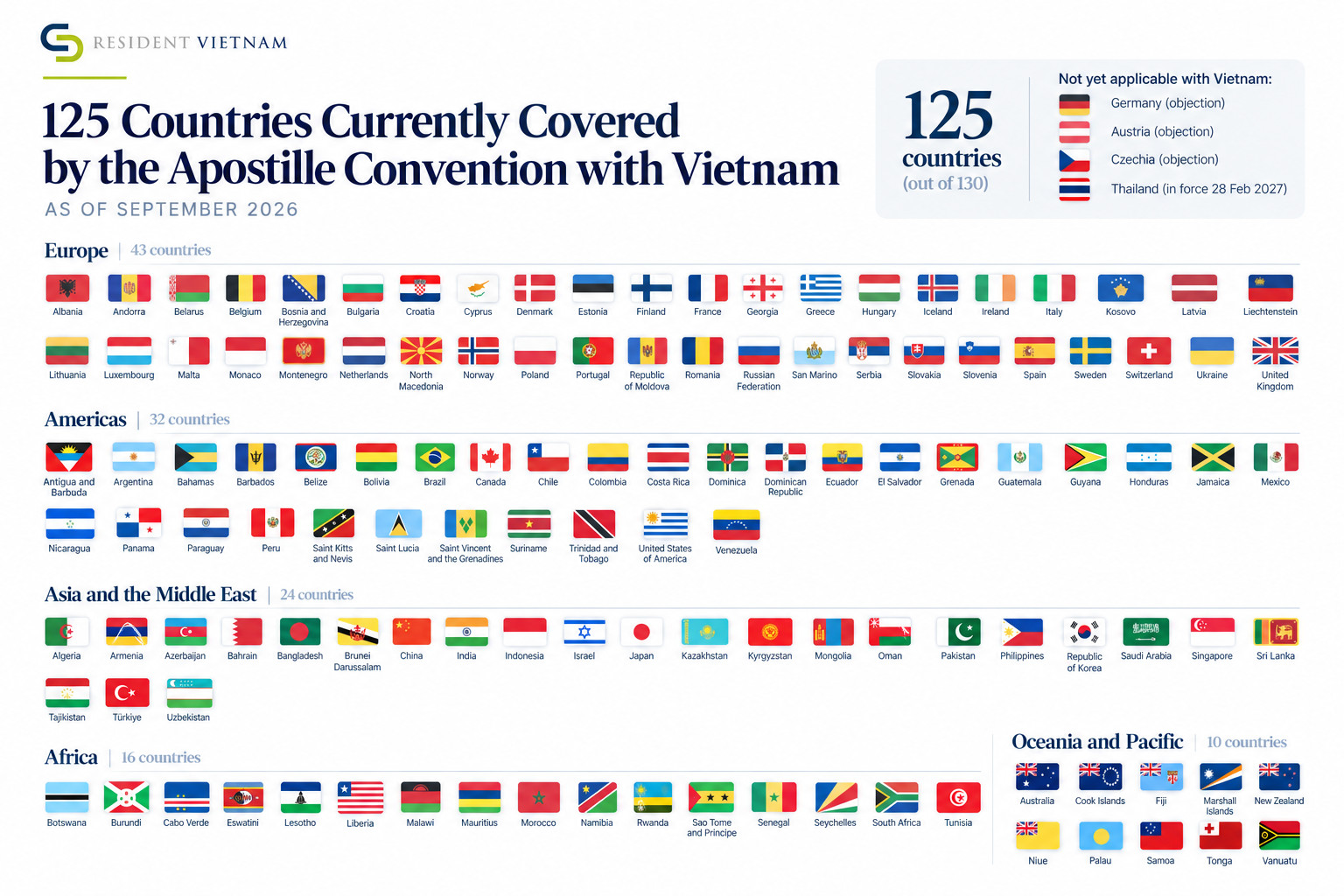
As of 29 September 2026, the Hague Apostille Convention has 130 Contracting Parties.
However, the Convention does not operate identically between every pair of countries. For Vietnam, it is currently applicable with 125 other Contracting Parties.
Germany, Austria and Czechia have formally objected to Vietnam’s accession, so the Convention does not apply between Vietnam and these three countries. Thailand is also not yet operational with Vietnam because its accession will only enter into force on 28 February 2027.
The countries below are the Contracting Parties with which the Apostille Convention is currently applicable for documents exchanged with Vietnam:
Europe
Albania, Andorra, Belarus, Belgium, Bosnia and Herzegovina, Bulgaria, Croatia, Cyprus, Denmark, Estonia, Finland, France, Georgia, Greece, Hungary, Iceland, Ireland, Italy, Kosovo, Latvia, Liechtenstein, Lithuania, Luxembourg, Malta, Monaco, Montenegro, Netherlands, North Macedonia, Norway, Poland, Portugal, Republic of Moldova, Romania, Russian Federation, San Marino, Serbia, Slovakia, Slovenia, Spain, Sweden, Switzerland, Ukraine, United Kingdom.
Asia and the Middle East
Algeria, Armenia, Azerbaijan, Bahrain, Bangladesh, Brunei Darussalam, China, India, Indonesia, Israel, Japan, Kazakhstan, Kyrgyzstan, Mongolia, Oman, Pakistan, Philippines, Republic of Korea, Saudi Arabia, Singapore, Sri Lanka, Tajikistan, Türkiye, Uzbekistan.
Americas
Antigua and Barbuda, Argentina, Bahamas, Barbados, Belize, Bolivia, Brazil, Canada, Chile, Colombia, Costa Rica, Dominica, Dominican Republic, Ecuador, El Salvador, Grenada, Guatemala, Guyana, Honduras, Jamaica, Mexico, Nicaragua, Panama, Paraguay, Peru, Saint Kitts and Nevis, Saint Lucia, Saint Vincent and the Grenadines, Suriname, Trinidad and Tobago, United States of America, Uruguay, Venezuela.
Africa
Botswana, Burundi, Cabo Verde, Eswatini, Lesotho, Liberia, Malawi, Mauritius, Morocco, Namibia, Rwanda, Sao Tome and Principe, Senegal, Seychelles, South Africa, Tunisia.
Oceania and Pacific
Australia, Cook Islands, Fiji, Marshall Islands, New Zealand, Niue, Palau, Samoa, Tonga, Vanuatu.
Important: This list is a snapshot of the Convention’s status as of September 2026. The applicable procedure should always be checked based on the country of origin, document type and intended use. The official HCCH status table remains the authoritative reference for the Convention’s current status and any future changes.
Frequently Asked Questions About Legalizing Foreign Documents in Vietnam
How do I legalize a foreign document for use in Vietnam?
The process depends on the country that issued the document and the type of document involved. Depending on the circumstances, the document may need an Apostille or traditional consular legalization, followed by translation and any other procedures required by the Vietnamese authority receiving it.
What is the difference between Apostille and legalization?
An Apostille is a standardized certificate used under the Hague Apostille Convention. Where the Convention applies, it replaces the traditional consular legalization process for eligible public documents. Traditional legalization remains relevant where the Apostille Convention does not apply or where another rule requires it.
Does Vietnam accept Apostilled documents?
Yes. Since 11 September 2026, eligible foreign public documents bearing a valid Apostille can be used in Vietnam without additional consular legalization when the Apostille Convention applies between Vietnam and the country concerned.
Does an Apostille replace notarization?
No. Apostille and notarization serve different purposes. A document may require notarization, certification or another supporting procedure in addition to an Apostille, depending on the document and the intended use.
Do foreign documents need to be translated into Vietnamese?
Translation requirements depend on the procedure and the authority receiving the document. An Apostille does not automatically remove the need for Vietnamese translation or other certification requirements.
Can I use an Apostille for any foreign document?
No. The Apostille Convention primarily applies to public documents, and certain documents fall outside its scope. You should verify both the nature of the document and whether the Convention applies between the relevant countries.
Do documents from Germany, Austria and the Czech Republic require traditional legalization?
As of September 2026, these three countries have objected to Vietnam’s accession to the Apostille Convention. The applicable traditional legalization process therefore remains relevant for documents exchanged between these countries and Vietnam unless another legal arrangement applies.
Can Resident Vietnam help with foreign document legalization?
Yes. Resident Vietnam provides consular and document services in Vietnam, including legalization coordination, notarization support, document certification and related administrative procedures.
Through our established network of international partners, we can also coordinate legalization and apostille procedures for documents issued abroad, covering most countries worldwide. This allows us to support clients throughout the document authentication process, both in Vietnam and overseas.
Foreign Document Legalization Services in Vietnam

Determining the correct procedure for a foreign document can be difficult when multiple authentication, legalization, translation and notarization requirements apply.
Resident Vietnam assists international companies, foreign professionals and individuals with document-related procedures in Vietnam, including legalization, authentication, notarization and supporting documentation.
Our team can help determine the appropriate route based on the document type, country of issue and intended use, and coordinate the required administrative steps.
Learn more about Resident Vietnam’s Consular & Document Services or contact our team to discuss your requirements.