
Vietnam’s new Decree 393 marks a further step towards attracting the foreign expertise needed to support the country’s development. It introduces additional pathways for skilled professionals, simplifies certain administrative requirements and strengthens employer accountability.
Decree 393/2026/ND-CP was issued on 20 October 2026 and is scheduled to take effect on 5 December 2026, replacing Decree 219/2025/ND-CP from that date.
From an immigration practitioner’s perspective, the overall direction is largely one of liberalization and talent attraction, balanced by more structured compliance requirements.
Vietnam is increasingly aligning its work-permit policies with its ambitions in semiconductors, artificial intelligence, advanced manufacturing, digital transformation and strategic technologies.
For employers and foreign professionals, the changes bring opportunities but also details that deserve attention.
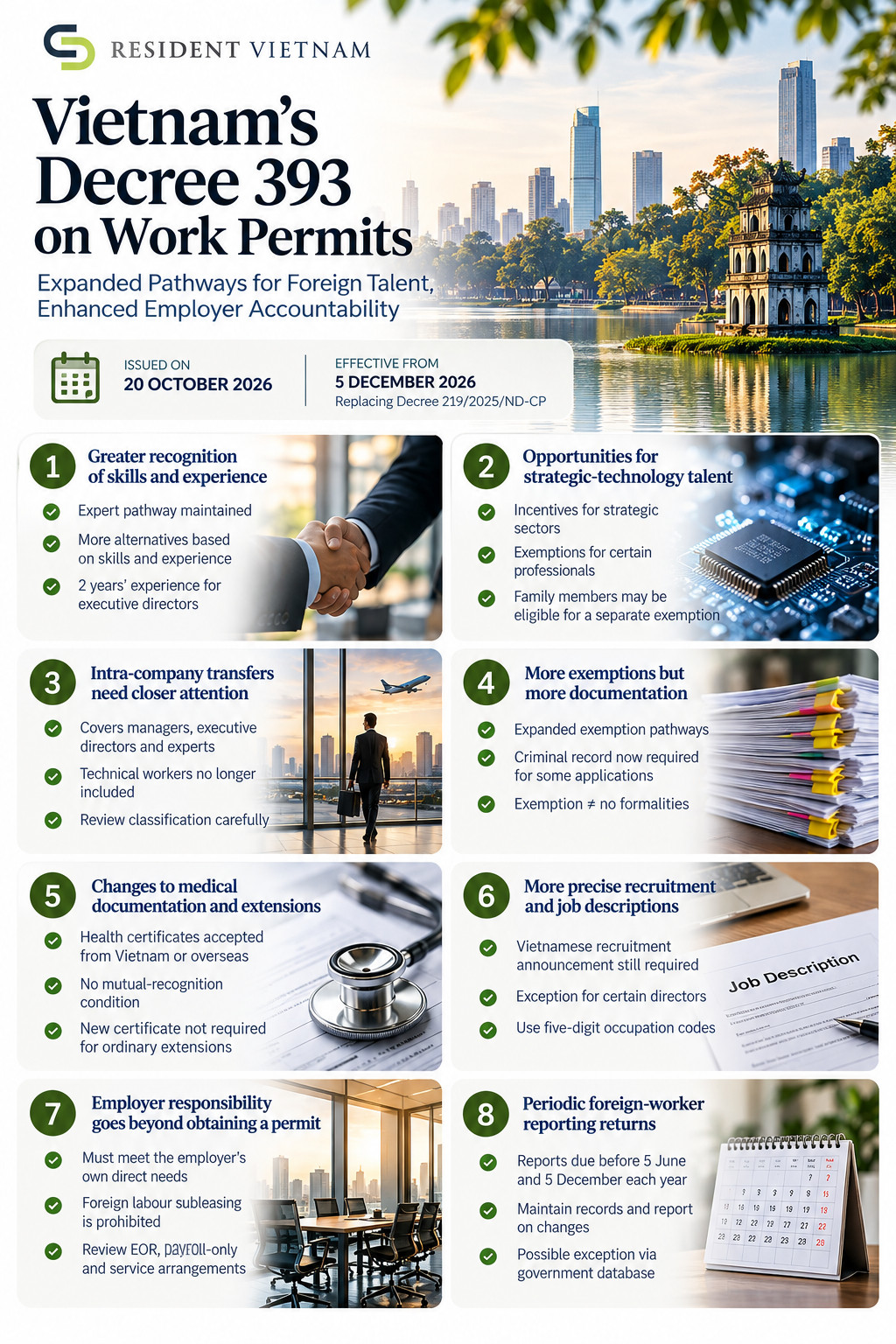
Greater Recognition of Skills and Professional Experience
The conventional expert pathway, based on a university qualification and at least two years of relevant experience, remains a central route for foreign professionals.
However, Decree 393 adds alternatives that place greater value on specialized skills, innovation potential and proven professional expertise. These changes reflect a broader talent-attraction strategy, supporting strategic industries, research, education and Vietnam’s development as a knowledge-based economy.
For the executive-director category covering someone who directly manages a field of activity, the decree specifies two years of relevant experience. However, eligibility still depends on evidence of genuine managerial authority. An English-language job title alone is not sufficient.
Opportunities for Strategic-Technology Talent
The decree introduces specific incentives and work-permit exemption pathways for certain strategic-technology professionals and qualifying family members. These provisions do not create a blanket exemption for everyone working in technology; eligibility depends on the relevant category and its requirements.
Qualifying family members of strategic-technology professionals who hold an exemption certificate should not assume that their family status alone authorizes them to begin working in Vietnam. Their sponsoring entity must submit a separate application for a work-permit exemption certificate.
This represents a significant departure from the current framework, making Vietnam more attractive to strategic-technology talent by facilitating employment opportunities for qualifying family members.
Intra-Company Transfers Need Closer Attention
The intra-company transfer framework is defined around managers, executive directors and experts. Technical workers are no longer included as a separate category within that definition.
This distinction matters when planning international assignments. A technical worker with three years of relevant experience may meet the requirements for the technical-worker category itself, but doesn’t make them eligible for work permit application under intra-company transfer scheme.
To qualify through the new experience-based expert pathway and be eligible for ICT scheme, they would need to meet its higher experience requirement. Employers should therefore review the proposed classification rather than assume that an existing assignment structure will remain suitable.
More Exemptions Do Not Always Mean Less Paperwork
Decree 393 expands the available work-permit exemption pathways, but some exemption-certificate applications become more document-intensive.
In particular, criminal-record evidence is added to the initial exemption-certificate dossier. For affected applicants, this means arranging police-clearance documentation that was not previously part of the application requirements.
The distinction between being exempt from a work permit and completing the required exemption formalities remains important.
Changes to Medical Documentation and Extensions
For work-permit applications, the decree provides for health certificates issued by competent medical institutions in Vietnam or overseas. It no longer includes the express mutual-recognition condition found in the earlier government explanation of Decree 219 for the health check certificate issued overseas.
For ordinary work permit renewal, a new health certificate is not listed in the required dossier. This reduces one administrative step for the relevant extension procedures.
The maximum initial duration of work permits and exemption certificates generally remains two years. An exception applies to qualifying intra-company transfer exemption certificates within the relevant WTO service sectors, which may be issued for up to three years.
More Precise Recruitment and Job Descriptions
Employers must continue to pay attention to the Vietnamese recruitment-announcement requirement for applicable work-permit categories. The decree includes an exception for the specified general director or director already named on the business registration document.
Applications also require more precise occupational descriptions, using five-digit occupation codes rather than the three-digit codes used under Decree 219.
For employers, this reinforces the importance of consistency between recruitment information, the proposed role and the work-permit application.
Employer Responsibility Goes Beyond Obtaining a Permit
Decree 393 expressly requires foreign employment to meet the employer’s own direct needs and prohibits foreign labour subleasing.
This deserves particular attention where arrangements involve:
- Employer-of-record services, which we previously highlighted with greater detail in our article on this topic.
- Payroll-only sponsorship;
- Foreign employees placed under a client’s management;
- Service contracts that, in substance, supply personnel.
This does not mean that every outsourced service is prohibited. A service provider delivering its own contracted service is different from a company supplying workers to another business. The actual supervision, employment relationship and contractual structure must be assessed.
Periodic Foreign-Worker Reporting Returns
Decree 393 reintroduces an express periodic reporting obligation for employers of foreign workers, following its omission from Decree 219. Under the earlier Decree 152 framework, reports were due before 5 July and 5 January. The new decree sets different deadlines: before 5 June and before 5 December each year.
Employers must also maintain paper or electronic records and report when requested by the competent local authority or when there are changes in their use of foreign workers.
An exception applies where the relevant information can be retrieved from the foreign-worker database. Employers should confirm how this exception operates in practice rather than assume that a previous permit application removes the need to report.
The change combines a return to periodic employer reporting with the possibility of reducing duplicate submissions through connected government databases.
What Employers Should Take Away
Decree 393 reflects a more targeted approach to attracting foreign talent: broader recognition of expertise, specific support for strategic sectors and fewer administrative requirements in selected procedures.
At the same time, employers need to look beyond the initial approval. Correct classification, consistent recruitment information, appropriate employment arrangements and ongoing reporting remain central to compliance.
For businesses planning foreign recruitment or international assignments, the practical starting point is to review each case against the relevant pathway and update internal procedures accordingly.
Planning to Hire Foreign Talent in Vietnam?

Resident Vietnam helps companies navigate work permit applications, exemption procedures and immigration requirements for foreign employees.
Explore our work permit and immigration services or contact our team to discuss your company’s needs.