
Relocating an employee to Vietnam involves much more than arranging a flight and finding accommodation.
For international companies, a successful foreign employee relocation requires coordination between HR, Global Mobility, the employee, immigration specialists and local service providers. From work authorization and document preparation to housing, school searches, settling-in and payroll, several processes need to be coordinated before and after the employee arrives.
This guide by Resident Vietnam provides a practical employer checklist for relocating employees to Vietnam, helping HR and Global Mobility teams understand what needs to be prepared and when.
What Does an Employer Need to Prepare When Relocating an Employee to Vietnam?
A corporate relocation to Vietnam typically involves several parallel workstreams rather than one single procedure. At a minimum, employers should plan for:
- Assignment planning: confirming the employee’s role, location, start date and assignment structure;
- Work authorization and immigration: determining the appropriate legal pathway before work begins;
- Document preparation: collecting, authenticating, legalizing or apostilling and translating required documents;
- Relocation and destination services: arranging housing, orientation, school searches and settling-in support;
- Arrival and settling-in: helping the employee and family complete practical tasks after arrival;
- Payroll and ongoing administration: ensuring local employee administration is properly organized.
The exact requirements depend on the employee’s circumstances, the sponsoring entity, the destination city and the nature and duration of the assignment.
1. Confirm the Assignment Before Starting the Relocation Process
The first step is to establish exactly what the relocation involves. Before starting immigration or destination services, the employer should confirm:
- The employee’s nationality;
- The employee’s current country of residence;
- The Vietnamese entity or organization involved;
- The employee’s job title and responsibilities;
- The intended work location or locations in Vietnam;
- The expected start date;
- The expected duration of the assignment;
- Whether the employee will relocate alone or with family members;
- Whether the employee is transferring within a multinational group or joining a Vietnamese entity locally or coming to work at another company in Vietnam (partner, client, contractor etc…).
These details are important because they affect both the immigration assessment and the relocation services that may be required. For example, an employee transferring from a regional headquarters to a Vietnamese subsidiary requires a different work authorization assessment from someone being recruited directly into a local position.
2. Determine the Employee’s Work Authorization and Immigration Pathway
Before the employee starts working in Vietnam, the employer should determine the appropriate work authorization and immigration pathway. Vietnam’s current foreign-worker framework provides different routes depending on the employee’s circumstances. Depending on the case, the employee may require a Work Permit, qualify for a Work Permit exemption, or fall under another applicable procedure.
The employer should therefore avoid assuming that every international assignment follows the same process. Resident Vietnam’s Corporate Immigration & Work Authorization services can help employers assess the appropriate pathway and coordinate the required procedures. For detailed information about standard work authorization, see our guide to Vietnam Work Permit Requirements, Timeline & Process. Where an exemption may apply, employers should also review our dedicated guide to the Work Permit Exemption Certificate (WPEC).
3. Start Document Preparation Early
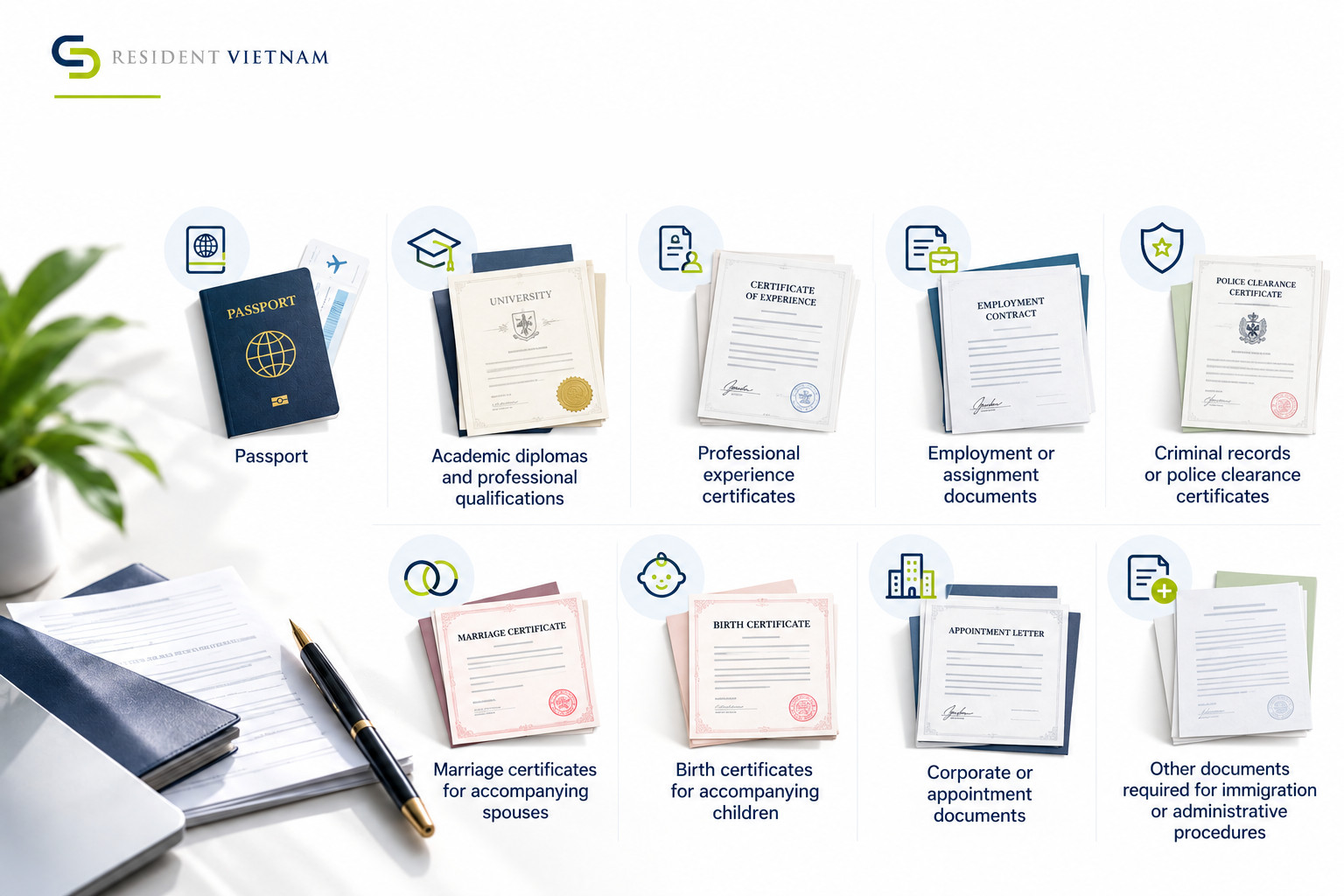
Foreign employee relocation projects can be delayed by documents long before the employee arrives in Vietnam. Depending on the employee’s situation, the employer may need documents such as:
- Passport;
- Academic diplomas and professional qualifications;
- Professional experience certificates;
- Employment or assignment documents;
- Criminal records or police clearance certificates;
- Marriage certificates for accompanying spouses;
- Birth certificates for accompanying children;
- Corporate or appointment documents;
- Other documents required for immigration or administrative procedures.
Some foreign-issued documents may require authentication, Apostille or consular legalization, translation and notarization before they can be used in Vietnam. Since Vietnam’s Apostille Convention framework became effective on 11 September 2026, eligible public documents from countries with an applicable relationship with Vietnam may follow an Apostille route instead of traditional consular legalization. However, the correct process depends on the country of origin, document type and intended use. For this reason, document requirements should be assessed as soon as the relocation is confirmed rather than immediately before the employee’s start date. Resident Vietnam provides Consular, Legalization & Document Services for companies and foreign professionals handling these procedures in Vietnam.
4. Plan the Employee’s Accommodation

Housing is often one of the first practical concerns for an employee relocating to Vietnam. Corporate relocation planning should establish whether the employee needs:
- Temporary accommodation during the first weeks in Vietnam;
- A long-term rental property; furnished or unfurnished
- Support identifying suitable residential areas;
- Assistance with property visits;
- Support understanding rental arrangements and tenancy requirements.
The preferred location will depend on the employee’s workplace, family situation, school requirements and personal preferences. For employees relocating to Hanoi or Ho Chi Minh City, local knowledge can be particularly useful when comparing neighbourhoods, commuting requirements, housing options and access to international schools. Resident Vietnam provides Home Search & Temporary Accommodation as part of our corporate destination services in Vietnam. For more information, read our guide “Where Do Expats Live in Vietnam? Best Cities & Neighborhoods”.
5. Consider the Needs of Accompanying Family Members

A relocation involving a spouse or children requires considerably more planning than an individual employee move. Employers and Global Mobility teams should establish early whether family members will accompany the employee and identify their practical requirements. These may include:
- Dependent immigration procedures;
- Temporary or permanent accommodation;
- International school research and applications;
- Area orientation;
- Settling-in support;
- Spousal support;
- Other practical assistance after arrival.
Family requirements can also influence the choice of neighbourhood and accommodation, so they should be considered alongside the employee’s workplace rather than treated as a separate issue at the end of the relocation process. Resident Vietnam provides school search, settling-in and spousal support services for relocating employees and their families across Vietnam.
6. Organize the Employee’s Arrival in Vietnam
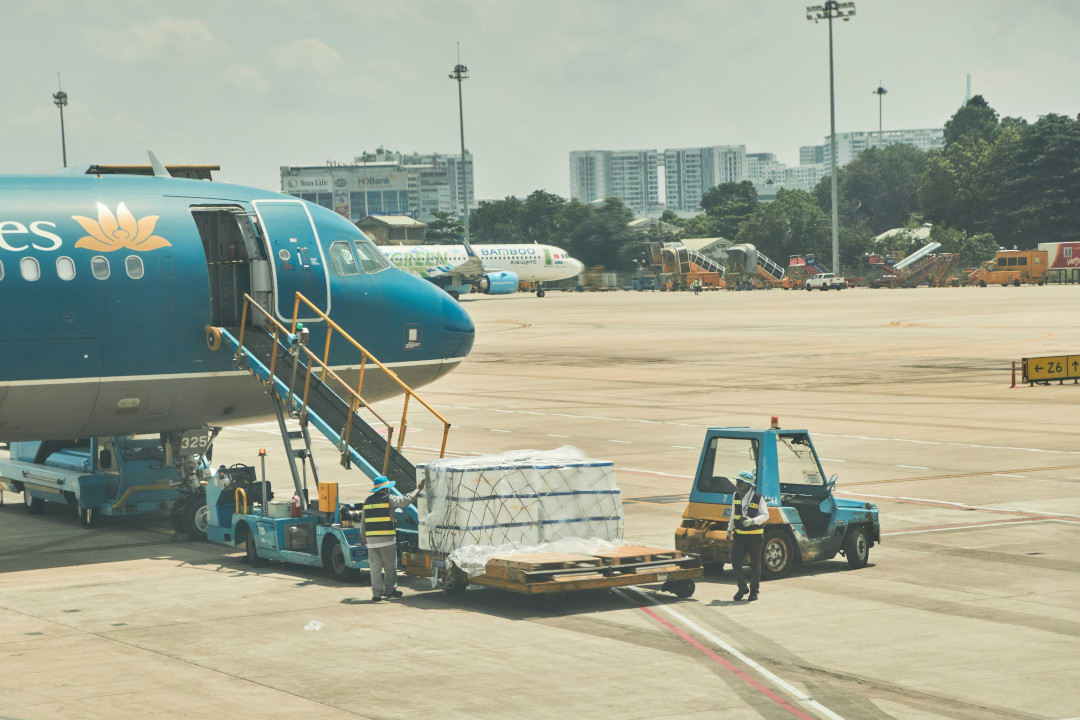
The relocation process does not end when the employee lands in Vietnam. A well-planned arrival should address the practical tasks required during the first days and weeks in the country. Depending on the assignment, employers may need to coordinate:
- Airport or arrival arrangements;
- Transportation to temporary accommodation;
- Area orientation;
- Home search appointments;
- School visits;
- Local administrative procedures;
- Immigration appointments and supporting formalities;
- Other settling-in requirements.
The objective is to allow the employee to move from arrival to a functioning daily routine as efficiently as possible. This is the role of destination services: connecting the employee with the local information, services and practical support required to settle into Vietnam.
7. Plan for Settling-In and Everyday Life
The first few weeks after arrival can have a significant impact on the employee’s relocation experience. Depending on the employee and family situation, settling-in support may include assistance with:
- Understanding the local area;
- Finding appropriate housing;
- School searches;
- Local administrative procedures;
- Daily practical arrangements;
- Transportation and mobility requirements;
- Other settling-in needs.
These services are particularly useful for employees who are moving to Vietnam for the first time and may have little familiarity with the local environment. For an overview of the full relocation experience, see our Corporate Relocation & Destination Services in Vietnam.
8. Coordinate Payroll and Employee Administration
Once the employee is established in Vietnam, the employer also needs to consider how their local employment and payroll administration will be managed. This is particularly important for international companies whose HR and payroll functions are coordinated between Vietnam and an overseas headquarters. Before the employee starts working, companies should determine:
- Who will manage local payroll administration;
- How employee information will be shared between local and international HR teams;
- Which payroll processes need to be managed locally;
- How payroll will be coordinated with the employee’s employment structure;
- Which local administrative requirements apply to the employee.
Resident Vietnam now provides dedicated Payroll Services in Vietnam for companies looking for local payroll administration and support.
9. Review Ongoing Immigration and Labour Compliance
Relocation does not end once the employee has received the appropriate authorization and moved into their new home. Employers should continue to monitor the employee’s situation throughout the assignment. This can include changes to:
- The employee’s role or responsibilities;
- Work location;
- Assignment duration;
- Corporate structure or sponsoring entity;
- Immigration status;
- Work authorization;
- Family circumstances.
Changes that appear operationally minor can sometimes affect the immigration or labour requirements applicable to the employee. For this reason, companies should integrate immigration compliance into the employee’s entire assignment lifecycle rather than treating it as a one-time administrative task. Our guide to Immigration Compliance in Vietnam provides a broader overview of employer responsibilities and ongoing compliance.
Foreign Employee Relocation to Vietnam: Employer Checklist
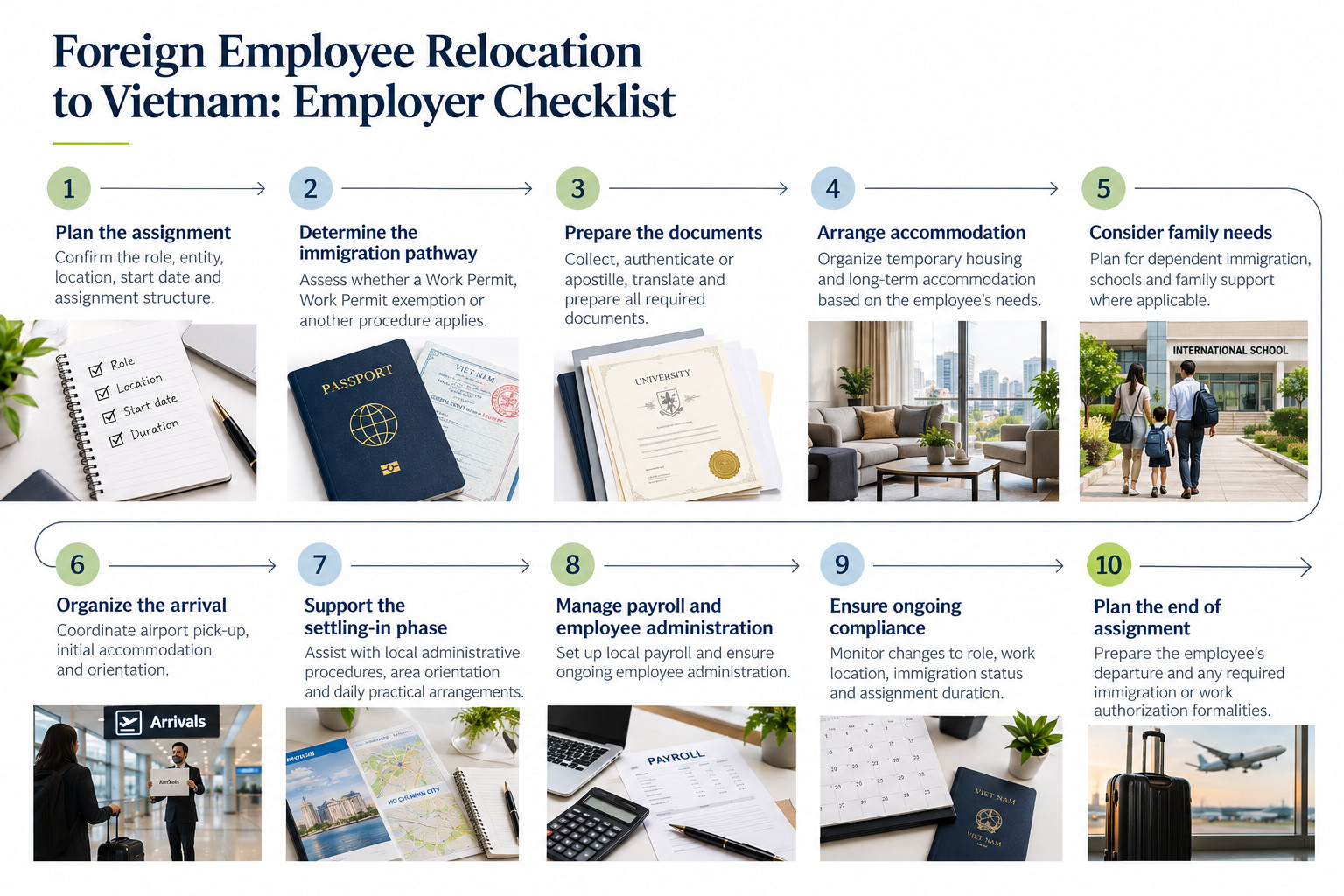
The following checklist provides a practical starting point for HR and Global Mobility teams planning an employee relocation to Vietnam.
| Relocation stage | What the employer should prepare |
| Assignment planning | Confirm role, entity, location, start date, assignment duration and accompanying family. |
| Immigration assessment | Determine the appropriate work authorization and immigration pathway. |
| Document preparation | Identify foreign documents and determine whether authentication, Apostille, legalization, translation or notarization is required. |
| Housing | Assess temporary accommodation and long-term housing requirements. |
| Family relocation | Plan dependent immigration, school search, housing and family support where applicable. |
| Arrival | Coordinate arrival arrangements, orientation and initial administrative requirements. |
| Settling-in | Support the employee and family with local practical arrangements. |
| Payroll | Confirm how local payroll and employee administration will be handled. |
| Ongoing compliance | Monitor changes affecting work authorization, immigration status, work location and the assignment. |
| End of assignment | Plan the employee’s departure and any required immigration, document or work authorization formalities. |
How Early Should Employers Start Planning a Vietnam Relocation?
There is no single timeline that applies to every international employee relocation to Vietnam. The required preparation time depends on the employee’s nationality, assignment structure, documents, immigration pathway, destination city and family situation. However, employers should begin the process as soon as the assignment is confirmed, particularly when foreign-issued documents need authentication, Apostille or consular legalization. A practical approach is to work backwards from the employee’s required start date and identify the potential critical-path items first:
- Work authorization and immigration assessment;
- Foreign document preparation and authentication;
- Housing and family requirements;
- Arrival and settling-in arrangements;
- Payroll and ongoing employee administration.
This approach allows HR teams to identify potential delays before they affect the employee’s start date.
Common Relocation Mistakes Employers Should Avoid
International companies can reduce avoidable delays by identifying the most common problems before the relocation begins.
Housing and other allowances not clearly defined and fully agreed upon with the employer before the employee begins the assignment.
It is often recommended that the company establish a clear assignment budget and communicate all applicable allowances upfront. The assignee and accompanying family members should then be offered a look-see trip to Vietnam before the assignment begins, giving them the opportunity to explore schooling options, understand local housing conditions, and make informed decisions before accepting the assignment.
Starting Immigration Procedures Too Late
Waiting until the employee’s departure date is approaching can leave insufficient time to prepare foreign documents or resolve issues with work authorization.
Treating Every Employee Relocation the Same Way
An intra-company transfer, local hire, investor, short-term assignment and executive appointment can involve different immigration and administrative requirements.
Ignoring the Family Until After the Employee Arrives
School requirements, dependent immigration and housing needs can significantly influence the relocation plan and should be assessed before the move.
Separating Immigration From Destination Services
Work authorization and relocation planning are often interconnected. The employee’s work location, assignment structure and expected start date can influence both immigration and practical relocation requirements.
Assuming the Relocation Ends on Arrival
Employees often require support after arriving in Vietnam, particularly during the settling-in period. Ongoing assistance can be just as important as preparation before departure.
Frequently Asked Questions About Employee Relocation to Vietnam
What should an employer do first when relocating an employee to Vietnam?
Start by clearly defining the assignment conditions and budget, including housing, schooling and other applicable allowances, and ensure these are communicated and agreed upon with the employee. The employer should also confirm the Vietnamese sponsoring entity, job role, work location, start date, assignment duration, and whether family members will relocate with them. These details will determine the appropriate immigration, relocation and destination services, and whether a pre-assignment look-see trip should be arranged to explore housing, schooling and other practical considerations before the move.
Does a foreign employee always need a Work Permit in Vietnam?
No. Some foreign nationals may qualify for a Work Permit exemption or another applicable pathway. The employer should assess the employee’s specific circumstances before assuming that a standard Work Permit is required. Vietnam’s foreign-worker framework under Decree 219/2025/NĐ-CP provides the current legal framework for these procedures.
Which documents should an employer prepare before relocating an employee?
The required documents depend on the employee and immigration pathway. They may include a passport, ideally valid beyond the expected end date of the assignment, diplomas, professional qualifications, experience certificates, employment or assignment documents and, where applicable, criminal records, marriage certificates and birth certificates. Foreign-issued documents may also require authentication, Apostille or legalization, translation and notarization.
How early should a company start an employee relocation to Vietnam?
There is no universal statutory deadline for the entire relocation project. In practice, companies should begin as soon as the assignment is confirmed. The first items to assess should be work authorization and foreign documents, because authentication or legalization can take significantly longer than the final submission itself.
Can employers help employees find accommodation when relocating to Vietnam? ?
Yes, it can. Corporate relocation services can include area orientation, home search, temporary accommodation assistance and lease support, depending on the employer’s relocation programme and the assignee’s needs.. Resident Vietnam provides these services as part of its corporate relocation services in Vietnam.
What if the employee is relocating with a spouse or children?
The employer should identify accompanying family members before the relocation plan is finalized. Dependent immigration, accommodation, school searches and settling-in support can then be incorporated into the relocation programme instead of being handled after the employee arrives.
Does an employee relocation project include payroll?
Payroll is normally part of the employee’s ongoing local administration rather than the relocation itself. However, international companies should establish how local payroll and employee administration will be handled before the employee starts working in Vietnam. Resident Vietnam provides dedicated Payroll Services in Vietnam.
What happens after the employee arrives in Vietnam?
The relocation process normally moves into the settling-in phase. Depending on the employee’s circumstances, this can include accommodation, school search, local orientation, immigration appointments, administrative procedures such as opening a bank account or obtaining a driving license and other practical arrangements needed to establish a daily routine in Vietnam.
One Local Partner for Employee Relocation and Immigration to Vietnam

Managing an international employee relocation requires coordination across several different areas. Immigration, document preparation, housing, family support, settling-in and ongoing employee administration all need to fit together around the employee’s assignment. Resident Vietnam supports international companies and Global Mobility teams with corporate relocation, destination services, immigration, document services and payroll support in Vietnam. Our teams in Hanoi and Ho Chi Minh City provide local expertise and hands-on support throughout the employee relocation process.
Learn more about our Corporate Relocation & Destination Services, Corporate Immigration & Work Authorization, Consular, Legalization & Document Services and Payroll Services. Contact Resident Vietnam to discuss your employee relocation requirements in Vietnam.