A Police Clearance Certificate in Vietnam, officially known as a Judicial Record Certificate (Phiếu lý lịch tư pháp), is an important document for foreign nationals who have lived or worked in the country. It may be required for employment, work permit applications, immigration procedures, or visa and residency applications in another country.
However, obtaining a Vietnamese police clearance certificate is not always straightforward. The procedure depends on whether you currently reside in Vietnam or have already left, which type of certificate you need, and the requirements of the organization requesting it.
Vietnam also introduced important changes to its judicial record procedures in 2025 and 2026, including the transfer of issuing responsibilities to the Ministry of Public Security and updated rules on the use of criminal record information.
This guide by Resident Vietnam explains the different types of certificates, eligibility requirements, application procedures, costs, processing times, and how to obtain a Vietnamese police clearance certificate from abroad.
What Is a Police Clearance Certificate in Vietnam?
A Vietnamese Police Clearance Certificate is an official document providing information about an individual’s criminal record status as recorded by the competent Vietnamese authorities.
It is commonly referred to by several English names:
- Police Clearance Certificate
- Police Certificate
- Criminal Record Certificate
- Judicial Record Certificate
- Judicial Record Check
These terms generally refer to the Vietnamese Phiếu lý lịch tư pháp, although the precise certificate required depends on its intended purpose.
The document may be requested in situations such as:
- Applying for a work permit in Vietnam.
- Completing employment-related administrative procedures.
- Applying for immigration status, citizenship, or permanent residency in another country.
- Providing criminal record information to an authorized authority.
- Completing certain legal or administrative procedures involving a previous period of residence in Vietnam.
A Vietnamese Police Clearance Certificate reflects criminal record information maintained by Vietnamese authorities. It does not cover criminal records held by authorities in other countries, including the applicant’s home country.
However, depending on the purpose of the application procedure and the applicable requirements, a Vietnamese Police Clearance Certificate may be required if you lived in Vietnam for a certain period of time.
Police Clearance Certificate No. 1 vs. No. 2: What’s the Difference?
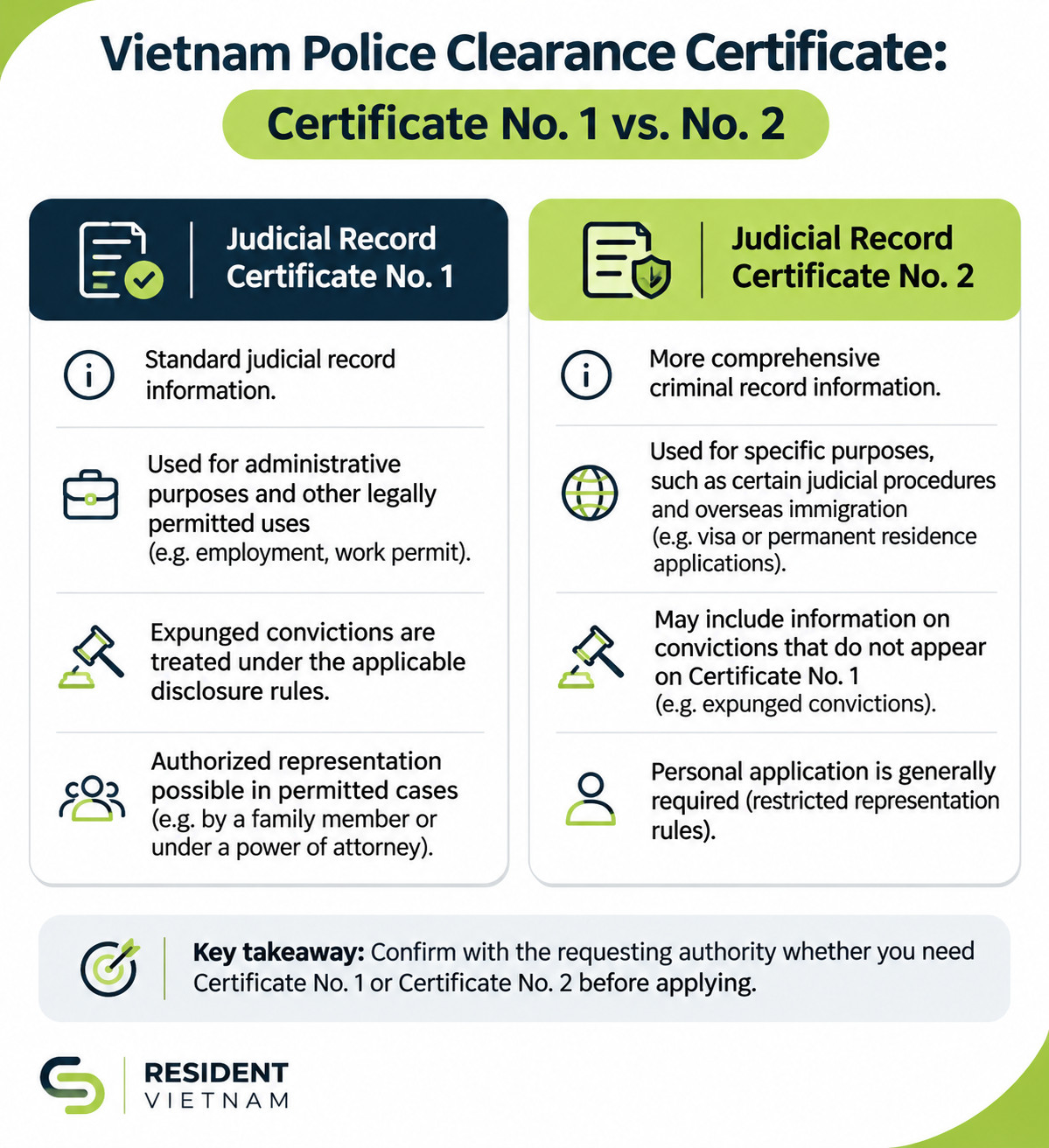
Vietnam has two main types of Judicial Record Certificates: Certificate No. 1 (Phiếu lý lịch tư pháp số 1) and Certificate No. 2 (Phiếu lý lịch tư pháp số 2).
Although both concern criminal record information, they have different purposes and disclosure rules.
Judicial Record Certificate No. 1
Certificate No. 1 generally discloses unspent criminal convictions. Convictions that have been legally expunged are not normally disclosed.
It is commonly used for employment, work permit applications, professional licensing and other administrative procedures, subject to applicable legal requirements.
Under Law No. 107/2025/QH15, effective from July 1, 2026, the use and disclosure of judicial record information are subject to updated restrictions. The law is supplemented by Decree No. 216/2026/ND-CP and Circular No. 101/2026/TT-BCA.
Judicial Record Certificate No. 2
Certificate No. 2 provides a more comprehensive criminal record history, including both spent (expunged) and unspent convictions.
It is frequently required by foreign immigration authorities for visa, permanent residence and citizenship applications, particularly where a complete criminal record history is requested.
It is particularly sensitive and is subject to stricter restrictions on who may request it and for what purpose.
For example, some foreign immigration authorities specifically require Certificate No. 2 for visa or permanent residence applications.
Applicants should not assume that Certificate No. 1 will be accepted as an alternative.
Which certificate should foreigners request?
| Situation | What to check |
| Vietnamese work permit application | The certificate requirements under the applicable work permit regulations |
| Foreign immigration or permanent residence application | The exact certificate specified by the destination country’s immigration authority |
| Employment background check | Whether the employer has a legal basis to request the relevant information |
| Application after leaving Vietnam | The required certificate type and the procedure for former foreign residents |
Important: Always confirm the required certificate type before applying. Receiving the wrong certificate can result in additional administrative work and delays.
Who Can Apply for a Vietnamese Police Clearance Certificate?
Foreign nationals who currently reside in Vietnam, as well as those who previously resided in the country, may be eligible to request a Vietnamese Judicial Record Certificate.
The appropriate application procedure depends on their residence status.
Foreigners currently living in Vietnam
Foreign nationals currently residing in Vietnam can generally apply through the provincial-level police authority responsible for their place of residence.
For example:
- Hanoi: Foreign residents should contact the Hanoi City Police (Công an thành phố Hà Nội), specifically the department responsible for criminal records (Phòng Hồ sơ nghiệp vụ), to confirm the current application counter and submission arrangements.
- Ho Chi Minh City: Foreign residents should contact the Ho Chi Minh City Police (Công an Thành phố Hồ Chí Minh) and its criminal records department for the applicable procedures.
- Other provinces: Applicants should contact the provincial police authority where they currently reside.
Depending on their electronic identification status, foreigners may be able to apply online through the National Public Service Portal or VNeID. In-person and postal applications are also permitted under the amended legislation.
Applicants should verify the current reception address and opening hours before visiting, as administrative locations and procedures may change.
For official procedures, consult the Ministry of Public Security’s public service portal.
Foreigners who have already left Vietnam
Former foreign residents may also need a Vietnamese police clearance certificate.
This is particularly common when someone who previously worked in Vietnam applies for permanent residence, citizenship, employment authorization, or a visa in another country.
Their application is handled differently from that of a foreign national currently residing in Vietnam.
Applications from former foreign residents are generally directed to the competent criminal records department of the Ministry of Public Security.
The application may require authenticated documents and submission from overseas, as explained later in this guide.
Documents Required for a Police Clearance Certificate in Vietnam
The exact documentation depends on the certificate type, application method, and applicant’s residence status.
Foreign applicants should prepare the following documents as applicable.
1. Completed application form
Applicants must complete the appropriate Tờ khai yêu cầu cấp Phiếu lý lịch tư pháp (Application for a Judicial Record Certificate).
The official administrative procedure identifies several forms, depending on the application method:
- Form No. 01/2025/LLTP: Standard application submitted by an individual.
- Form No. 02/2025/LLTP: Applications involving authorized representation for Certificate No. 1, or certain applications made by parents on behalf of minors.
- Form No. 04/2025/LLTP: Interactive electronic application submitted by an individual.
- Form No. 05/2025/LLTP: Interactive electronic application for the specified representative or parental application situations.
For applications from abroad, additional forms or authentication instructions may apply. For example, the Vietnamese Embassy in Canada provides specific instructions for former foreign residents requesting Certificate No. 2.
Applicants should obtain the latest form directly from the relevant official procedure rather than relying on older templates circulating online.
Official sources:
- National Public Service Portal – Judicial Record Certificate application
- Vietnamese Embassy in Canada – Criminal Record Certificate
The application requires accurate identification and residence information. All details should match the applicant’s passport and previous Vietnamese immigration records.
2. Passport or identification documents
Applicants generally need to provide a copy of their valid passport.
Is a notarized passport copy required?
Not in every case. For in-person applications, applicants may generally present their original passport together with a photocopy for verification. If the original is not presented, a certified true copy may be required.
For applications submitted from abroad, additional authentication requirements may apply. For example, the Vietnamese Embassy in Canada requires applicants requesting Certificate No. 2 to have their passport copies certified.
Former residents should also prepare copies of previous passports used during their stay in Vietnam, particularly pages containing Vietnamese visas, entry and exit stamps, or residence information.
A notarized or consular-certified copy should not be arranged automatically without checking the requirements of the relevant submission procedure.
For overseas applications, passport copies and supporting immigration documents may need to be certified or authenticated before submission. Where required, certification can be arranged through a Vietnamese diplomatic mission overseas or an accepted notarial procedure in Vietnam.
Applicants should confirm whether copies of all passport and visa pages are required, including those from previous passports used during their residence in Vietnam.
3. Evidence of residence in Vietnam
Depending on the application, supporting documents may include:
- Temporary residence registration or confirmation or Temporary Residence Card (TRC).
- Previous visa or residence documents.
- Entry and exit stamps.
- Other documents establishing the applicant’s period of residence in Vietnam.
Former residents should retain these records when leaving Vietnam. They can be especially valuable if a police certificate is requested several years later.
4. Authorization or authenticated documents
The rules on representation and document authentication depend on the type of Judicial Record Certificate requested and the application method.
Example 1: Certificate No. 1 with an authorized representative
A foreign national living in Ho Chi Minh City who needs Certificate No. 1 may authorize another person to complete the permitted application procedures.
A written power of attorney may be required and must comply with the applicable authentication requirements.
Certain applications made by parents, spouses, children or legal guardians are subject to specific representation rules.
Example 2: Certificate No. 2 for an overseas immigration application
A former expatriate applying for Canadian permanent residence may need Vietnamese Judicial Record Certificate No. 2.
For an adult applicant, this certificate generally requires a personal application. The applicant should not assume that a friend, family member or commercial agent can submit the request under a standard power of attorney.
For former foreign residents applying from overseas, the established procedure for Certificate No. 2 is to submit the application directly to the competent criminal records department of the Ministry of Public Security in Vietnam, generally by international post or courier. Applicants should verify the current submission and authorization requirements before applying.
Example 3: Applying from Canada after leaving Vietnam
A former resident of Vietnam now living in Canada can follow the instructions published by the Vietnamese Embassy in Canada.
The procedure involves preparing the application form, having the applicant’s signature authenticated and obtaining certified passport copies before sending the documents to the competent authority in Vietnam.
The Embassy authenticates the relevant documents but does not itself issue the Judicial Record Certificate.
Example 4: Applying from another country
An applicant living in France, Australia or another country should check the authentication arrangements available through the relevant Vietnamese embassy or consulate.
Requirements may differ depending on the applicant’s location, the certificate type and the submission procedure.
Official references:
- Vietnamese Embassy in Canada – Criminal Record Certificate
- US Department of State – Vietnam Police Certificates
How to Apply for a Police Clearance Certificate While Living in Vietnam
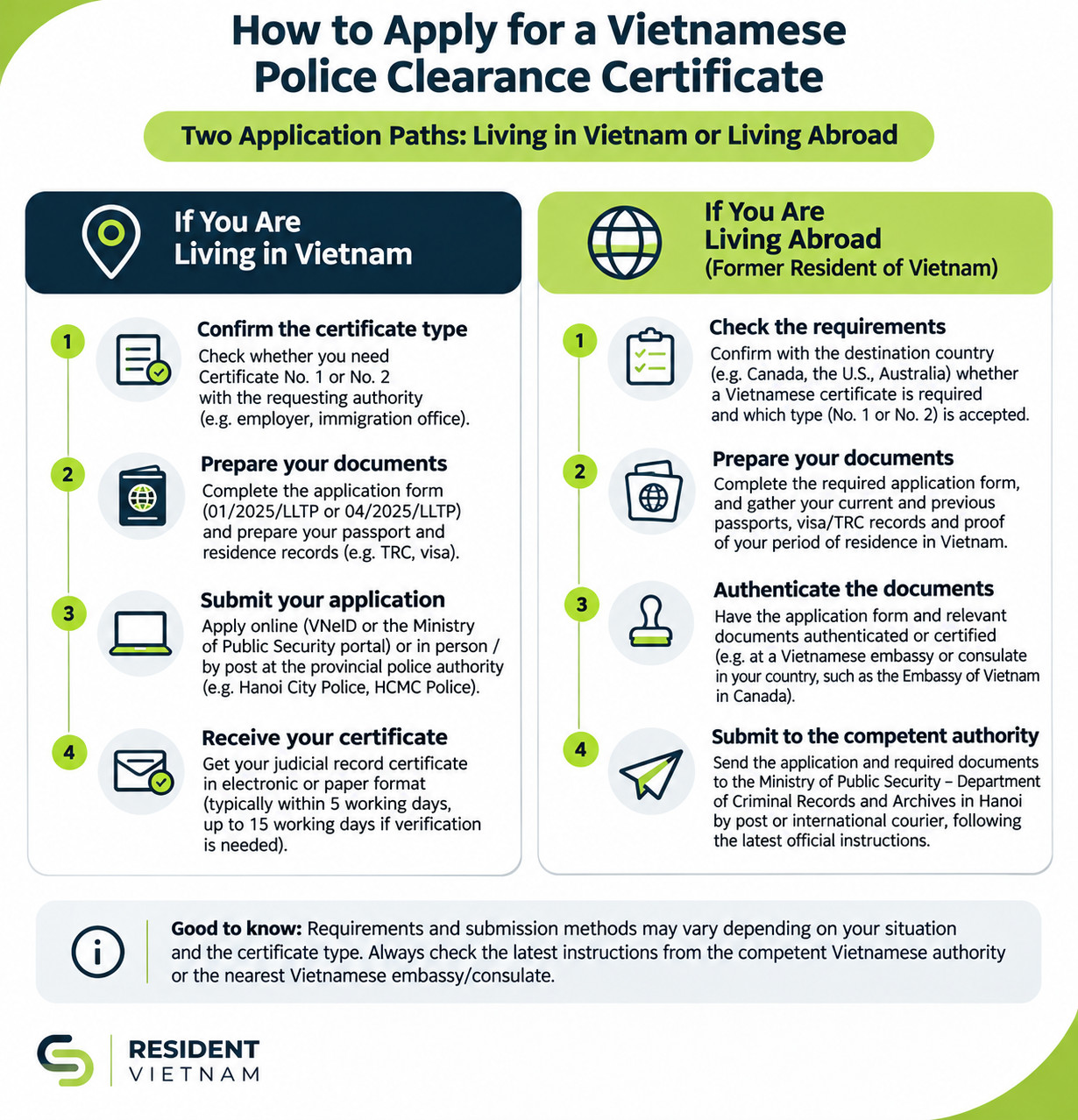
For foreign nationals currently residing in Vietnam, the application generally follows the steps below.
Step 1: Confirm which certificate you need
Before preparing the application, ask the requesting authority whether it requires Certificate No. 1 or Certificate No. 2.
If the certificate is intended for a work permit application, confirm the applicable immigration and employment requirements.
If it is intended for an overseas visa application, consult the destination country’s official immigration instructions.
Step 2: Identify the competent authority
Since March 2025, responsibility for issuing Vietnamese Judicial Record Certificates has been transferred from the justice authorities to the police system.
For foreigners currently residing in Vietnam, the competent authority is generally the provincial-level police authority responsible for their place of residence.
This is an important change because many older online guides still direct applicants to the provincial Department of Justice.
Step 3: Prepare the application documents
Complete the correct application form and prepare your passport and any required residence documentation.
Check that names, dates of birth, passport numbers, and residence history are consistent.
Discrepancies can result in requests for clarification or additional verification.
Application options for Certificate No. 1
Former foreign residents applying for Certificate No. 1 generally have two possible application routes:
Option 1 – Direct application: Submit the completed application dossier to the competent Vietnamese authority by international post or courier.
Option 2 – Authorized representative: Authorize a representative in Vietnam to submit the application on their behalf, supported by a Power of Attorney that meets the applicable authentication or legalization requirements.
Applicants should confirm the accepted submission method and document requirements with the competent authority.
Step 4: Submit the application
The available submission methods include:
- The National Public Service Portal, where applicable.
- The VNeID application, where the applicant has the necessary electronic identification.
- In-person submission.
- Postal submission, where permitted.
Under the rules effective from July 2026, online submission is generally the standard approach, while foreigners and individuals without electronic identification can use the permitted in-person or postal procedures.
Useful resource: Vietnam National Public Service Portal
Step 5: Pay the applicable fee
The standard government fee is generally VND 200,000 per application.
Additional charges may apply for extra copies, postal delivery, document authentication, or other supporting services.
Step 6: Receive your certificate
Once the application has been processed, the certificate is issued in the applicable electronic or paper format.
Electronic and paper judicial record certificates have equal legal validity under Vietnamese law.
However, an overseas authority may impose its own document presentation requirements, including a paper original.
Check the receiving authority’s requirements before choosing how to obtain and submit the certificate.
How to Obtain a Vietnamese Police Clearance Certificate from Abroad
Foreign nationals who previously lived in Vietnam frequently discover that they need a Vietnamese police clearance certificate only after moving to another country.
For example, a former expatriate may need to provide a Vietnamese police certificate when applying for Canadian permanent residence, an Australian visa, or another immigration program that requires criminal record information from countries of previous residence.
You do not necessarily need to return to Vietnam to apply. However, applications from overseas require additional preparation.
Step 1: Check the destination country’s requirements
Start by confirming:
- Whether a Vietnamese police clearance certificate is required.
- Whether Certificate No. 1 or No. 2 is accepted.
- Whether an original paper document is mandatory.
- Whether translation or legalization is required.
- Whether the certificate must have been issued within a particular period.
Requirements differ between countries and immigration programs.
For example, both the United States and Canada identify Vietnamese Certificate No. 2 as the relevant police certificate for certain immigration procedures.
Step 2: Gather evidence of your previous residence
Prepare your current passport and, where possible, previous passports used while living in Vietnam.
Other useful documents may include an expired TRC, previous visas, and records showing your Vietnamese residential address and dates of residence.
These documents help establish your identity and connection to Vietnam.
Step 3: Prepare and authenticate the application
Applicants abroad may need to complete a specific application form and authenticate their signature and passport copies through an appropriate Vietnamese diplomatic mission.
The Vietnamese Embassy in Canada, for example, provides instructions for former residents applying for Certificate No. 2 and explains that it authenticates application documents rather than issuing the certificate itself.
The precise requirements should be checked with the competent Vietnamese authority and the relevant embassy or consulate.
Step 4: Submit the documents to Vietnam
Applications from former foreign residents are generally handled by the Ministry of Public Security’s competent criminal records department.
For Certificate No. 2, official guidance for overseas applicants identifies the following address:
Ministry of Public Security – Department of Criminal Records and Archives
54C Tran Hung Dao Street, Cua Nam, Hanoi, Vietnam.
For Certificate No. 2 applications submitted by former foreign residents from overseas, the established procedure involves sending the application directly to the competent criminal records department of the Ministry of Public Security in Vietnam by international post or courier.
Certificate No. 2 applications are subject to restrictions on third-party representation. Applicants should not assume that a representative in Vietnam can submit the application on their behalf.
Because administrative arrangements can change, verify the receiving office, current form, payment instructions, and return-delivery arrangements before dispatching original documents.
Step 5: Arrange delivery of the certificate
Applicants should confirm how the completed certificate will be returned.
Where an original paper certificate is required for overseas immigration purposes, plan for international delivery and allow additional time for document verification, courier handling, and any subsequent translation or legalization.
Can someone apply on your behalf from Vietnam?
This depends on the certificate type and the applicable authorization rules.
For Certificate No. 1, former foreign residents may generally authorize a representative in Vietnam to submit their application, subject to a properly executed and authenticated Power of Attorney and the applicable administrative requirements.
Certificate No. 2 is subject to more restrictive rules. Applicants should not assume that a friend, relative, or service provider can submit the application as their representative.
Professional assistance may still be useful for reviewing documentation, explaining procedures, coordinating authentication, and arranging permitted administrative support.
How Long Does It Take to Obtain a Vietnamese Police Clearance Certificate?
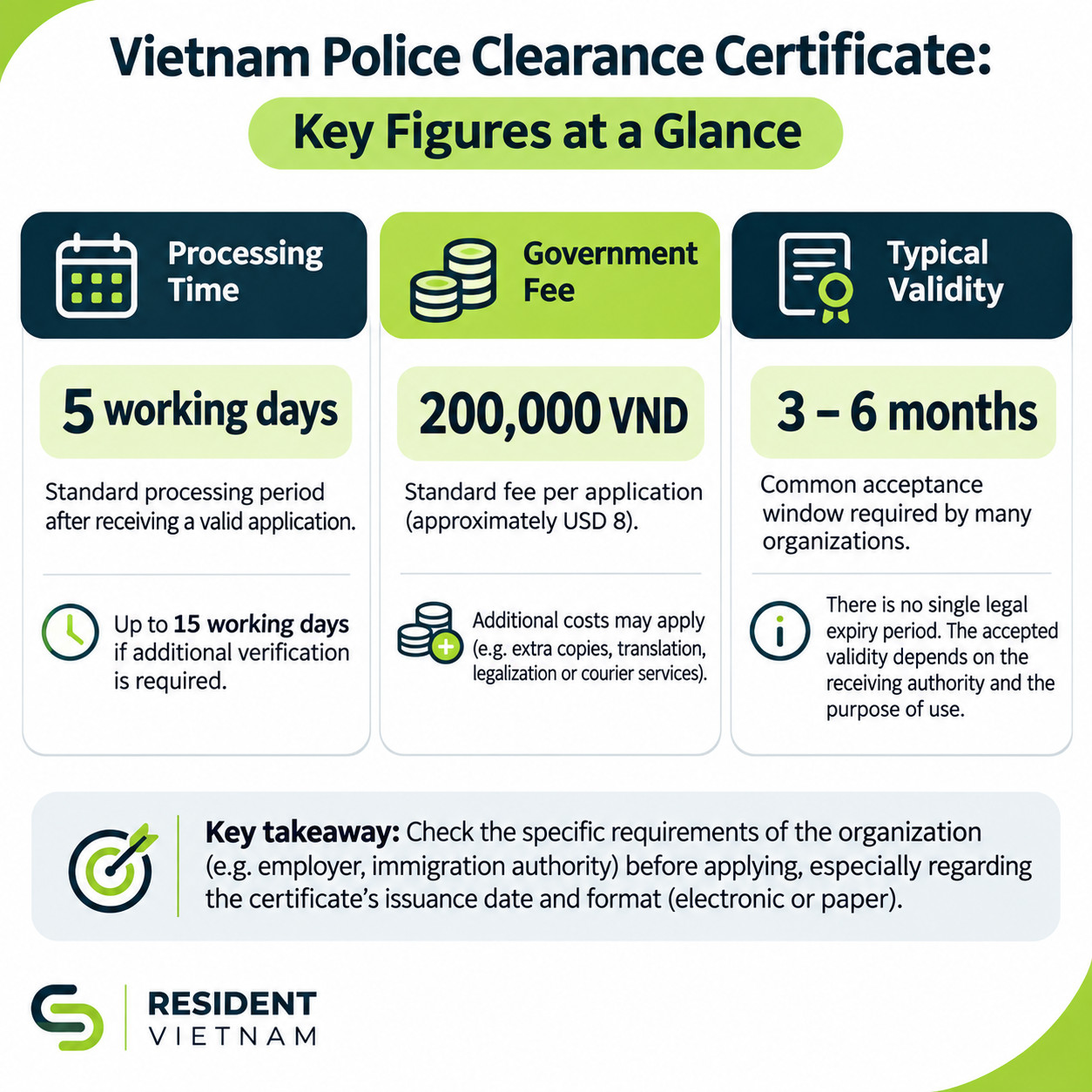
Under the updated 2026 framework, the standard statutory processing period is generally five working days after receipt of a valid application, with additional time possible where verification is required.
More complex cases may take up to 15 working days under the applicable verification rules.
These periods concern administrative processing and do not necessarily include:
- Time spent obtaining missing documents.
- Corrections to incomplete applications.
- Embassy authentication.
- International shipping.
- Translation or legalization.
- Additional requirements imposed by the receiving country.
For applicants outside Vietnam, the overall process may therefore take considerably longer than the certificate’s statutory processing period.
For Certificate No. 2 applications submitted from overseas, applicants should generally allow approximately 10–15 working days for processing after the competent authority has received and accepted the complete application and applicable fees. International postal delivery, document authentication and any additional verification requirements may extend the overall timeframe.
It is advisable to begin preparing the application well before an immigration or employment deadline.
How Much Does a Vietnamese Police Clearance Certificate Cost?
The standard administrative fee is generally VND 200,000 per applicant.
Reduced fees or exemptions may apply to certain eligible categories under Vietnamese regulations.
Where more than two certificates are requested in a single application, an additional charge may apply to subsequent copies.
Applicants should distinguish the official government fee from other potential expenses, such as:
- Document certification or authentication.
- Translation.
- Courier services.
- International delivery.
- Professional administrative assistance.
For overseas applicants, these additional expenses can exceed the certificate issuance fee itself.
Does a Vietnamese Police Clearance Certificate Need Translation or Legalization?
Not necessarily. The answer depends on where the certificate will be used and which authority is requesting it.
Using the certificate in Vietnam
For a Vietnamese administrative procedure, a Vietnamese-language certificate may be accepted without further translation.
However, the requesting authority may impose specific documentary requirements.
Using the certificate abroad
An overseas immigration office, employer, or public authority may request an English translation, a certified translation, or an authenticated original.
Some authorities accept a Vietnamese certificate accompanied by a translation, while others specify particular certification requirements.
Where legalization or an Apostille is relevant, the applicable international arrangements and the receiving country’s rules must be checked.
Do not automatically arrange legalization before confirming what the receiving authority actually requires.
Resident Vietnam also provides guidance on consular documentation and legalization services.
Common Problems When Applying for a Vietnamese Police Clearance Certificate
Applying for the wrong certificate
Certificate No. 1 and Certificate No. 2 are not interchangeable. Always verify the required type before applying, particularly for overseas immigration procedures.
Using outdated application instructions
Older guides may still refer applicants to the Department of Justice. The issuing authority changed in 2025, and further procedural amendments took effect in July 2026. Applicants should use current instructions from the competent police authority.
Missing previous passport or residence records
Former residents may have difficulty proving their residence history if they no longer possess their old passports, visas, or residence documents. Gathering these records early can reduce delays.
Assuming a representative can handle every application
Authorization rules vary, and Certificate No. 2 is particularly restricted. A representative’s ability to assist with document preparation does not necessarily mean they can legally submit the application on the applicant’s behalf.
Underestimating international processing time
For applications from abroad, document authentication, courier delivery, and return shipping can add significant time. Plan for the entire process rather than relying only on the statutory certificate issuance period.
Frequently Asked Questions
Can a foreigner obtain a police clearance certificate in Vietnam?
Yes. Foreign nationals who currently reside or previously resided in Vietnam may apply, subject to the applicable requirements and procedures.
Can I obtain a Vietnamese police clearance certificate after leaving Vietnam?
Yes. Former foreign residents can apply through the competent Vietnamese authorities without necessarily returning to the country. Additional documentation and authentication may be required.
Is a Police Clearance Certificate the same as a Judicial Record Certificate?
In Vietnam, these English terms generally refer to the Phiếu lý lịch tư pháp. The important distinction is between Certificate No. 1 and Certificate No. 2.
Which certificate do I need for Canadian immigration?
Immigration, Refugees and Citizenship Canada identifies Judicial Certificate No. 2 as the required Vietnamese police certificate for relevant immigration applications. Always consult the current instructions for your specific application.
Which certificate do I need for US immigration?
The US Department of State identifies Certificate of Judicial Record No. 2 as the relevant Vietnamese police certificate for immigrant visa procedures.
Can I apply online through VNeID?
Yes. Eligible applicants can request a Vietnamese Judicial Record Certificate through the VNeID application or the official public service portals, provided they have the required electronic identification credentials.
The main official platforms are:
- Vietnam National Public Service Portal
- Ministry of Public Security Public Service Portal
- Ministry of Public Security Judicial Record Information System
Online applications generally require a Level 2 electronic identification account.
Foreign nationals without the necessary electronic identification can use the permitted in-person or postal procedures.
Applicants should note that online applications generally result in an electronic certificate. If a foreign immigration authority requires an original paper certificate, the appropriate paper issuance procedure should be confirmed before applying.
How long is a Vietnamese police clearance certificate valid?
Vietnamese Judicial Record Certificates do not have a single statutory expiry period applicable to every administrative procedure.
In practice, many organizations request certificates issued within the previous 3 to 6 months, although the accepted period depends on the receiving authority and the purpose of the application.
For example, Vietnamese work permit procedures generally require a criminal record certificate issued within six months before the relevant application date.
Foreign immigration authorities may apply different rules, including requirements based on when the applicant last lived in Vietnam.
Applicants should therefore check the specific requirements of the receiving authority and avoid obtaining the certificate too far in advance.
Can my employer request Certificate No. 2?
The 2026 regulations restrict organizations’ ability to request criminal record information, particularly Certificate No. 2. Employers should verify the legal basis for any requested certificate and avoid collecting more sensitive information than the law permits.
Can Resident Vietnam assist with a police clearance certificate?
Yes. Resident Vietnam provides administrative and consular document support for international companies, expatriates and former foreign residents who need a Vietnamese Police Clearance Certificate.
Our teams can assist with understanding certificate requirements, preparing supporting documents, coordinating permitted administrative procedures and identifying applicable authentication or legalization requirements.
The available assistance depends on the certificate type, the applicant’s residence status and the legal rules governing representation.
Learn more about our Consular, Legalization & Criminal Record Certificate Services or contact Resident Vietnam for assistance.
How Resident Vietnam Can Help

Obtaining a Vietnamese Police Clearance Certificate can involve several administrative steps, especially for foreign nationals who have already left Vietnam or need the document for an overseas immigration application.
Resident Vietnam assists international companies and expatriates with consular documentation, legalization requirements, immigration procedures, and related administrative support.
Our teams in Ho Chi Minh City and Hanoi can help you understand the applicable requirements, prepare documentation, and coordinate the administrative steps that can lawfully be handled on your behalf.
Whether you are applying for a Vietnamese work permit, preparing to relocate abroad, or requesting a judicial record certificate after leaving Vietnam, obtaining the correct document is essential.
Contact Resident Vietnam to discuss your situation and the available assistance.